
State Water Resources Control Board webinar walks suppliers through Urban Water Use Objective reporting, deadlines and form demo
Get AI-powered insights, summaries, and transcripts
Subscribe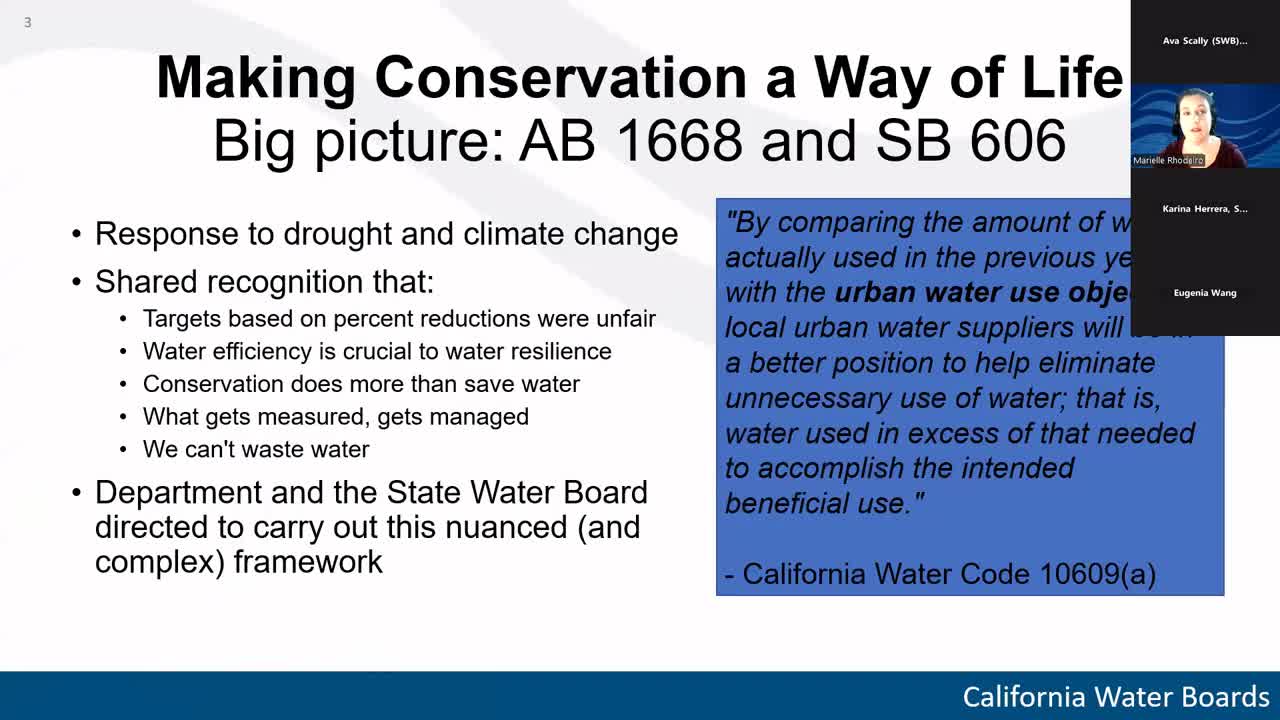
Summary
State Water Resources Control Board staff demonstrated the Urban Water Use Objective reporting form, summarized statutory requirements under AB 1668 and SB 606, explained data sources and refresh schedules, and reminded suppliers of key deadlines including a Jan. 1 submission date and an Oct. 1 variance cutoff.
Maria Rodero, a research data specialist in the Office of Research, Planning and Performance at the State Water Resources Control Board, led a webinar demonstrating how water suppliers should complete the Urban Water Use Objective reporting form and explaining the board’s review timeline and deadlines.
Rodero said the reporting framework stems from AB 1668 and SB 606, legislation enacted after California’s 2012–2017 drought that directed the Department of Water Resources and the State Water Resources Control Board to adopt data‑driven, localized water budgets and corresponding annual reporting requirements. "The resulting regulation establishes efficient water use standards and the corresponding formulas to calculate efficient water use budgets," she said.
Staff prefill many form fields using existing state datasets. Rodero described the workflow: staff aggregate supply and demand data from the SAFER Clearinghouse and water loss volumes from the Department of Water Resources, post those tables to the board’s open data portal, and load them into the reporting form via the open data API. She cautioned that the connection is not fully live: "the tables can be refreshed to reflect the latest updates to the data on the website," and the open data tables will be updated every Monday through mid‑December.
The demo covered form navigation and required materials. Rodero explained color coding used in the form (locked prefilled cells in blue/gray, mandatory fields in green, optional in gold, and cross‑hatched fields that should not be edited). She used Amador Water Agency as an example to show the summary tab and individual system budgets. For residential outdoor budgets she emphasized suppliers must enter a value (enter 0 if applicable) and noted some outdoor budgets may currently calculate as 0 while the Department of Water Resources supplies evaporation and effective precipitation data.
Water loss and audit options were highlighted: the form defaults to reported open data values but agencies may elect to use audit values ("water loss audit due January 2026") or an agency estimate by selecting the appropriate option and completing required audit fields. Rodero also explained the SBX7 by 7 backstop, describing it as a ceiling on the objective that includes the SBX7 by 7 target volume plus processed and recycled water.
For commercial, institutional and industrial (CII) customers, the webinar reviewed required best management practices (BMPs) reporting and classification progress. Rodero said full customer classification is not required until June 30, 2027, but suppliers must report progress now and may enter 'unknown' where data is unavailable this reporting cycle. She demonstrated selecting method 974C1 for identifying large CII water users and pointed to guidance spreadsheets with worked percentile examples for 97.5th and 80th percentile calculations.
Submission instructions: suppliers must upload the completed reporting form and a signed certification statement to the WUI data portal under the specified document types; the form and certification will be renamed on upload and the submitter should receive a confirmation email. Rodero advised agencies to register portal accounts early because approval can take time.
Staff review timeline and outputs: after Jan. 1 submissions staff will extract and QA/QC the reports, update open data, and generate compliance summaries. Rodero said agencies should expect a PDF summary around April with high‑level comparisons of objective versus reported use suitable for board or management review.
Key deadlines and next steps called out in the webinar: the board is not accepting variances or temporary provision requests for this cycle after the Oct. 1 cutoff; reports are due Jan. 1; water loss audit values are due January 2026; and full CII classification must be completed by June 30, 2027. Staff will hold virtual office hours on Nov. 18 and the presentation recording and slides will be posted to the board’s website.
The webinar includes guidance materials and FAQs on the board’s website and contact instructions for follow‑up questions (waterconservation@waterboards.ca.gov).