
PGCPS details expansion, funding and data plans for 147 community schools
Get AI-powered insights, summaries, and transcripts
Sign Up Free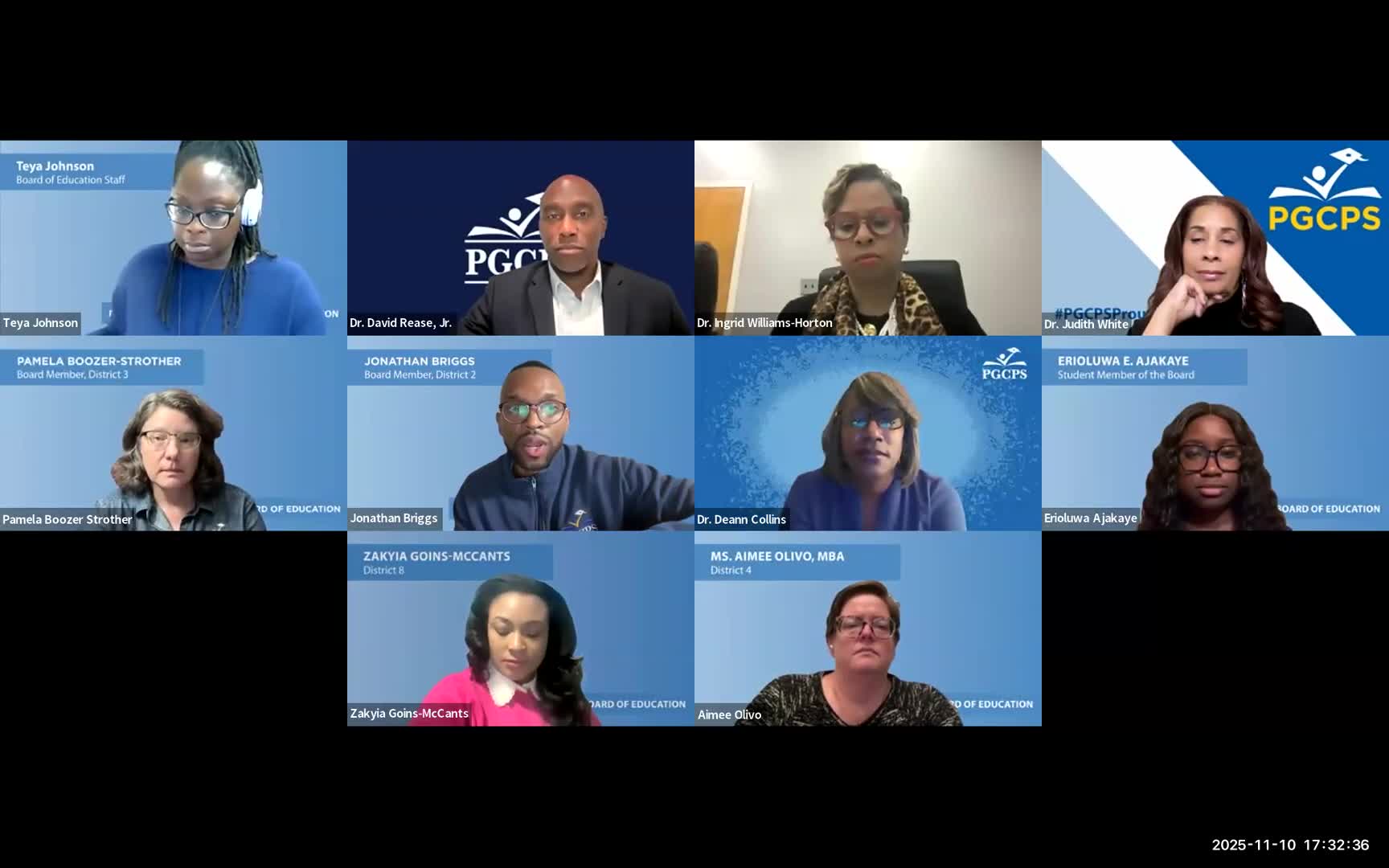
Summary
Prince George’s County Public Schools officials on Nov. 10 told the Academic Achievement Committee that the district now supports 147 community schools and is working to strengthen staffing, vendor oversight and family engagement as state grant funding expands.
Prince George’s County Public Schools officials on Nov. 10 told the Academic Achievement Committee that the district now supports 147 community schools and is working to strengthen staffing, vendor oversight and family engagement as state grant funding expands. The presentation laid out the office’s theory of action, the funding mechanics, and operational challenges that accompanied rapid scale-up from about 45 schools in the initial cohort.
The district’s associate superintendent for teaching, learning and innovation, Dr. Reese, said the Maryland State Department of Education provides concentration-of-poverty grants that are formula-driven and flow to eligible schools. He told the committee those grants include both a personnel component (to fund community school coordinators, registered nurses and mental-health clinicians) and a per-pupil component tied to the four‑year average of students living in poverty. “If the office of community schools strengthens the capacity of the community school coordinators… and monitors the impact of each of those wraparound services… PGCPS will be empowered to eliminate barriers to learning,” Reese said.
Why it matters: PGCPS described roughly $100 million in state grant funds this year tied to the community‑school effort and said that number, plus the district’s move from roughly 45 to 147 community schools, created new central-office demands for procurement, vendor oversight and data collection. Staff argued stronger central monitoring and a concise family-facing dashboard are needed so schools and families can see which services are working and how resources are allocated.
Staff described 13 categories of wraparound services that community schools may use the grants to support, including school- and community-based health services, nutrition and food-security programs, vision and dental screening, mental-health clinicians and family-engagement work. Dr. Ingrid Williams Horton, director of the Office of Community Schools, said partnerships in the district include Brighter Bites, Nima’s Garden and local food‑bank and farm arrangements. She described examples where district staff connected families to immediate housing or food resources through direct partnerships with county agencies.
Board members pressed staff on three operational issues. First, board members asked about CitySpan, a vendor-management and data platform the office has contracted to inventory vendors, track student participation, cost and program outcomes, and help triangulate vendor activity with MCAP and benchmark results. “We want to be able to work with an organization that can show us… our return on investment,” Williams Horton said.
Second, members raised concerns about consistency across 147 schools and the need for shared leadership between principals, community school coordinators and school‑based management teams. Board member Boozer Struthers requested clearer examples and convening of principals and coordinators so the district can model and scale best practices. Staff said they plan to use existing district convenings to advance shared‑leadership learning and professional development.
Third, several members urged clearer, parent‑facing dashboards. Struthers told staff that the newly published dashboards used many acronyms and lacked context for parents (MCAP, DIBELS, ACCESS, SWD, etc.), and she asked that community‑school activity and vendor contributions be integrated so families can see both academic and wraparound progress. Staff acknowledged the need for improved data literacy and context when presenting results to families.
No formal votes were required on the presentation; the committee adopted the meeting agenda and approved prior minutes by unanimous consent at the start of the session. Dr. Reese said the office will return to the committee in March for a field‑focused follow-up in which community school coordinators will discuss concrete evidence of program impact.
Quotation highlights from the hearing include Dr. Reese’s summary of the theory of action: “If the office of community schools strengthens the capacity of the community school coordinators… and monitors the impact of each of those wraparound services… PGCPS will be empowered to eliminate barriers to learning.” Dr. Williams Horton described a recent example of rapid family engagement growth: Cherokee Lane’s family participation increased from roughly 20 to about 60 attendees at recent events after targeted outreach and virtual options were used.
Next steps: staff said they will continue to refine procurement oversight, work with CitySpan to produce evaluative data, improve parent-facing dashboards and return in March with community school coordinators to present evidence from schools.