
District buys AI tutoring tool, expands K–12 literacy training and curriculum adoption
Get AI-powered insights, summaries, and transcripts
Subscribe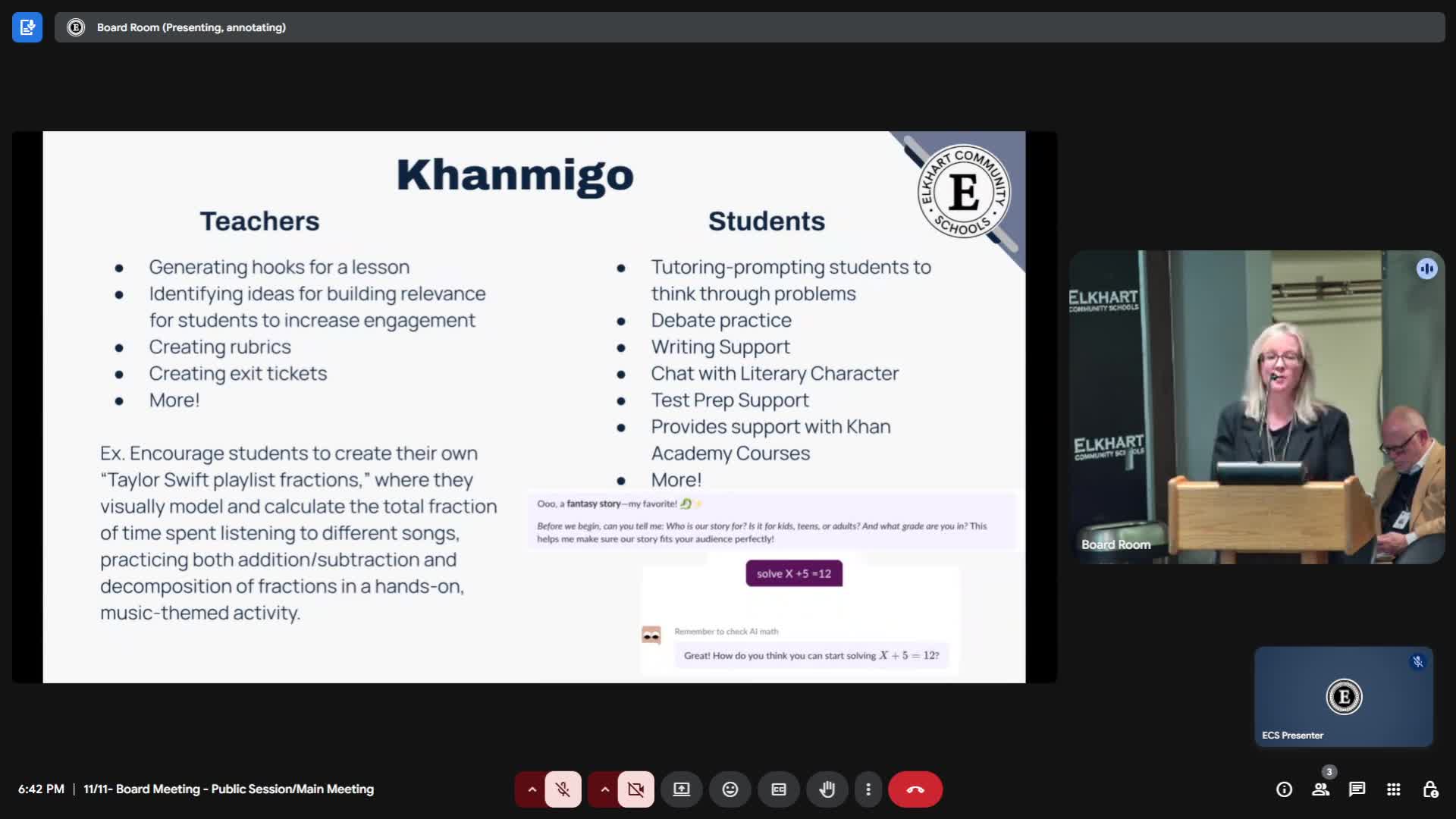
Summary
Elkhart’s director of professional learning outlined a year of training: a state grant-funded conference; LETRS literacy training focusing on language comprehension; K–8 Amplify and 9–12 CommonLit curricular alignment; and a state‑grant purchase of the AI tool Conmigo (about $62,000) for teacher and student supports.
Kristen Cederberg, the district’s director of professional learning, told the board she used a state grant to host a two‑day 'Journey to Excellence' conference and to purchase several resources to support K–12 literacy and teacher development.
Cederberg said approximately 440 teachers and administrators participate in the LETRS (Language Essentials for Teachers of Reading and Spelling) training that this year focuses on language comprehension; the district also adopted Amplify for K–8 and CommonLit for grades 9–12 to build a K–12, knowledge‑spiral approach to reading instruction that aligns with state literacy goals.
As part of teachers’ technology supports, the district purchased Conmigo — a Khan Academy tool — through a state grant. Cederberg described Conmigo as a teacher‑ and student‑facing AI that generates lesson hooks, rubrics and tutoring prompts and uses Socratic questioning to help students think through problems rather than delivering answers. She told the board the grant covered the tool’s roughly $62,000 cost and emphasized a staged rollout that started with high schools and will move to middle and elementary schools.
She also outlined supports for new teachers (three‑day orientation, monthly mentoring), syllabus and curriculum‑map integration, targeted training for exceptional learners and implementation coaching from outside partners. Board members asked whether paraprofessionals would receive similar training; Cederberg said paras are invited to sessions and that the district plans additional academy days for classified staff in spring.
The district’s professional learning work was framed as supporting iRead and iLearn literacy goals, aligning curriculum adoptions with classroom practice and preparing staff for synchronous learning days.
No board vote was required for the informational presentation.