Get Full Government Meeting Transcripts, Videos, & Alerts Forever!
Get email alerts on the Area Plan Engagement topic
No spam. Unsubscribe anytime.
Buncombe County staff test communitypreferences on hazard risk, housing and recreation ahead of December events
Summary
At a Buncombe County public workshop, staff presented future land use maps and poster-based exercises to test residents' risk tolerance for flood and hazard mitigation, gather transportation and recreation priorities, and solicit feedback on outreach materials ahead of a Dec. 3 in-person event.
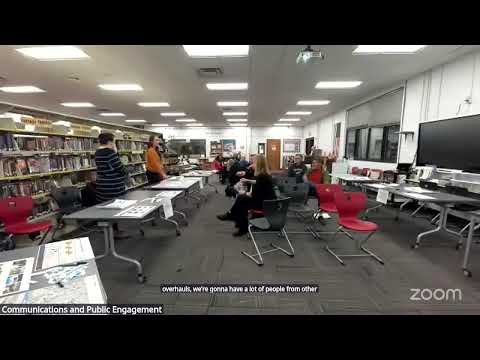
Planning staff opened a public workshop to test how residents balance hazard resilience, housing preferences and recreation priorities as part of an area plan engagement for Buncombe County. Staff said prior polling showed strong interest in significant change and that the December workshop will use poster stations and sticker-based exercises to test whether that preference holds when concrete standards are presented.
The presentation focused on a future land use map — a 10- to 20-year vision tool separate from zoning — and several table exercises asking attendees which housing types they would like to see in a highlighted area, what they consider the downtown boundary, and what businesses they want. "We have this minor, moderate, major [scale]," planning staff summarized, "The majority of people said we want major changes to help make Swannanoa more resilient to hazards in the future," and said staff would test those answers with examples of how minor, moderate and major changes would look.
Staff also sought input on transportation and recreation. The event will collect observed intersection problems and preferences for pedestrian and bicycle facilities and ask two greenway questions: support for a connected greenway system and support for an outdoor recreation economy. "Recreation economy" was described as including manufacturers and retailers of recreation equipment, outfitters and tour operators; staff said they would define the term on outreach materials.
Participants raised concerns about the engagement design and trade-offs between resilience standards and housing affordability. One participant urged avoiding a "false choice" between reducing hazard risk and keeping housing affordable, noting there are examples of low-income housing in Swannanoa that were not flooded and could offer models for safer sites. Planning staff and attendees discussed redesigning the risk-tolerance activity so it better communicates trade-offs — for example, a resource-allocation exercise that shows how higher resilience standards can increase costs and affect housing supply.
Attendees also asked about mapping and timing of floodplain updates. Planning staff said federal and state mapping processes drive floodplain changes and that updates can take several years to be fully reflected, telling the group the timing can be around five years. Cost barriers to development were highlighted in discussion: participants noted more protective stormwater systems (for example, 50-year versus 25- or 10-year systems) and stormwater mitigation requirements can add significant expense and make some smaller developments financially infeasible.
Staff discussed outreach logistics: large 2-by-3 poster boards will be displayed on easels with 11-by-17 versions on each table, and attendees will pick up a feedback packet at a welcome table. Youth engagement will include a puppet show and in-class activities for younger students and postcard or art-based options for older children. The primary in-person workshop is scheduled for Dec. 3; staff said a virtual option is in development and asked for volunteers to help staff additional sessions.
Next steps: staff will revise the risk-tolerance materials based on comments, clarify map labels and definitions, finalize posters for printing and recruit volunteers for the December outreach. The planning team will incorporate feedback into materials to be used at the Dec. 3 event.