
Marathon County DA outlines expansion and cost-benefit of deflection and diversion programs
Get AI-powered insights, summaries, and transcripts
Subscribe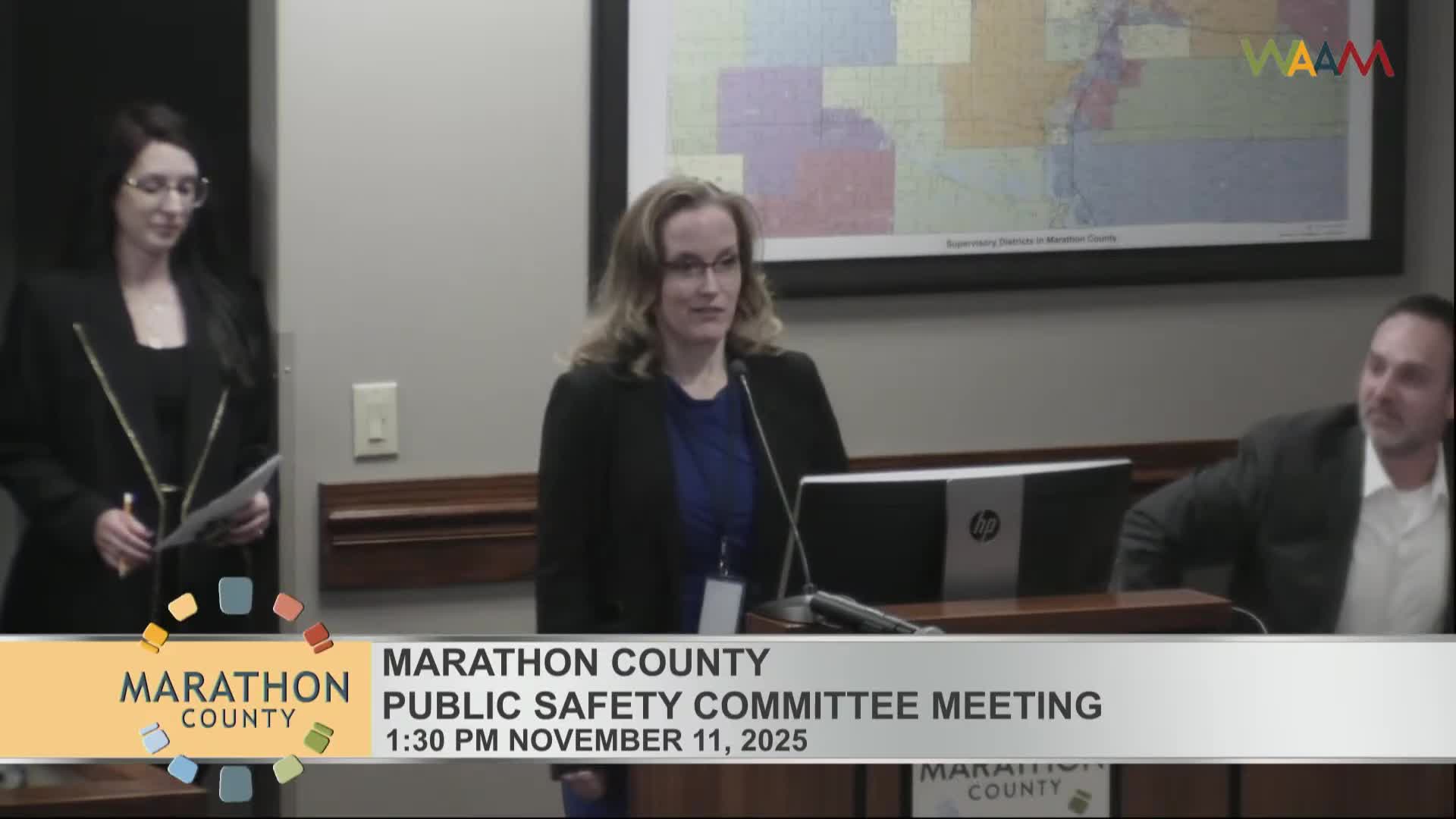
Summary
District Attorney Ruth Heinzel described Marathon County's deflection and diversion programs, their funding, measured outcomes, and plans to expand services to metro and rural areas.
District Attorney Ruth Heinzel presented a comprehensive update on Marathon County's deflection and diversion work, outlining staffing, funding sources, program models, expansion plans and measured outcomes.
Heinzel introduced her team: lead deflection specialist Dana Bittner, who works with law enforcement to connect people with substance use or mental health challenges to treatment and supports; diversion specialist Nikki Delatolas, who helps prosecutors design diversion offers; and a new deflection assistant focused on data entry and program support. Heinzel said the county's deflection work began about two years ago and has been supported by federal and state grant programs.
Funding: Heinzel said Dana's position moved from COSEP grant funding into state JAG funding on Oct. 1; the office also secured two COSEP grants (one focused on the Wausau metro area and a second on rural areas) that cover deflection specialists and treatment and support costs. COSEP was described as competitive; JAG funding is awarded to counties already participating in the deflection initiative and is renewed annually. Heinzel also described a $100,000 smart-prosecution grant to support a new pre-filing expedited program.
Model and expansion: Heinzel explained deflection as a law-enforcement-led intervention that routes eligible people with substance-use challenges into recovery capital (housing, food, treatment) rather than the traditional criminal justice pathway. The office is expanding in two cohorts: the Wausau metro expansion (co-response capacity, outreach to unhoused populations) and a rural expansion using the sheriff's office. Heinzel said the county acts as a regional mentor site within the Wisconsin Deflection Initiative (a DOJ-run program covering 13 counties).
Outcomes and data: Heinzel reported 287 deflection referrals since program inception, with active cases generally around 100 to 110 per specialist; historically the program reported about a 94% success rate. Heinzel cited cost-benefit figures drawn from a Washington State Institute for Public Policy meta-analysis and local grant-funded results: Washington State analyses suggested about $19,000 in benefits per person; Marathon County reported grant-funded net savings estimates (for one cited year) of roughly $1,172,000 tied to program outcomes and $3.23 million in combined pre/post diversion savings in a prior year. Heinzel emphasized that some programs are grant funded and that continued funding for new grants (for example, the smart-prosecution grant) remains uncertain.
Diversion specifics: Nikki outlined precharge tracks (first-time offender track, operating-after-revocation, truancy interventions) and postcharge tracks (more intensive agreements that can lead to amended or dismissed charges upon successful completion). Nikki and Ruth highlighted lower recidivism (~15'18% range) compared with state averages and described restitution collection (reported >$160,000 through 2023 for precharge diversion and nearly $1 million for postcharge diversion collections through 2023).
Heinzel closed by requesting routine public data for committee oversight (types of arrests triggering immigration checks, detainer counts, lengths of additional stays, reimbursements) and inviting continued collaboration with law enforcement and county staff as the programs expand. Committee members asked clarifying questions about grant terms, competitive status, and matching requirements; Heinzel said JAG is annual and not competitive for existing deflection participants, COSEP was competitive and guaranteed two years with a possible third, and no matching funds were required for the grants discussed.