
Milton police chief proposes code changes to curb camping on public property; council debates language and officer discretion
Get AI-powered insights, summaries, and transcripts
Sign Up Free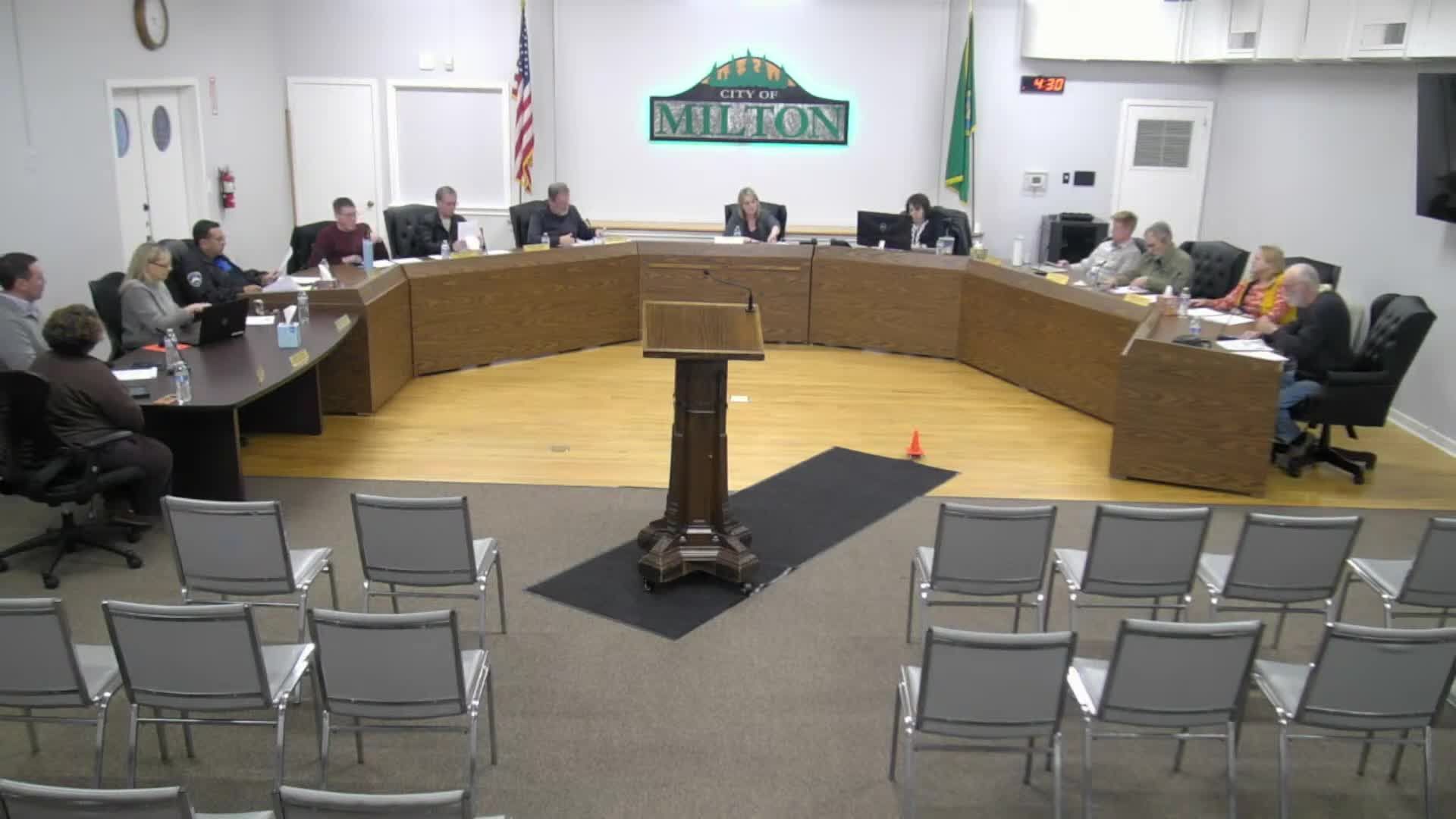
Summary
Police Chief Hernandez told the Milton City Council on Nov. 10 that city staff have drafted amendments to Chapter 9.55 of the Milton Municipal Code to better align local enforcement with recent judicial decisions and to give staff clearer authority to address camping on public property.
Police Chief Hernandez told the Milton City Council on Nov. 10 that city staff have drafted amendments to Chapter 9.55 of the Milton Municipal Code to better align local enforcement with recent judicial decisions and to give staff clearer authority to address camping on public property.
Hernandez said the changes are designed to protect both the rights of people experiencing homelessness and the public's ability to use and enjoy public spaces without hazards. He described recent enforcement challenges, including an encampment in a critical wetland where "we're able to clean out a very large encampment that was in a critical wetland area and, with human feces going into the water, large accumulations of food, drug use. We've had an OD there." Hernandez said the city has negotiated a trespass agreement with the Department of Transportation to allow enforcement on certain state-owned right-of-way.
Under the proposed language, officers would provide notice and a list of resources and have the authority to remove people who continue to camp after 24 hours unless there is an immediate public-safety threat that justifies immediate removal. Hernandez described other risks, including people sheltering on or near transformers and crash-prone intersections. "If we deem it to be public safety ... you gotta go right now," he said.
Council members pressed staff for details. Councilmember Strader asked for specific locations; Hernandez mentioned a site along I-5 where trespassers cut a hole through chain-link fencing to reach a wooded wetland. One councilmember asked whether the phrase "city personnel may arrest" in the draft means police officers; Hernandez confirmed arrest authority rests with police and said limited commissions can be granted but none have been issued.
The council also debated draft language that requires officers to "attempt to supply" resource information versus a stronger "shall supply" requirement. Councilmember Cedar argued that "attempt" is too weak and would reduce the city's obligation to help people access shelters or services, calling the change a "big policy shift" that effectively criminalizes camping. Hernandez and other council members defended the "attempt" language as preserving officer safety and discretion in volatile encounters.
Hernandez said the draft has undergone legal review and was written by the city attorney, who referenced comparable ordinances in other jurisdictions. Councilmembers asked staff to return with corrected grammar and to identify the statutory or case law models used in drafting; the item was set to return to the council on Monday for further review.
Why it matters: changes to municipal camping rules affect enforcement, shelter referrals and whether camping is treated primarily as a public-health/policy issue or a criminal offense. The council's choice of language will determine how officers balance outreach and enforcement and could influence future litigation or judicial review.