
Madison City Council renews, expands live-streaming policy after public push for broader access
Get AI-powered insights, summaries, and transcripts
Subscribe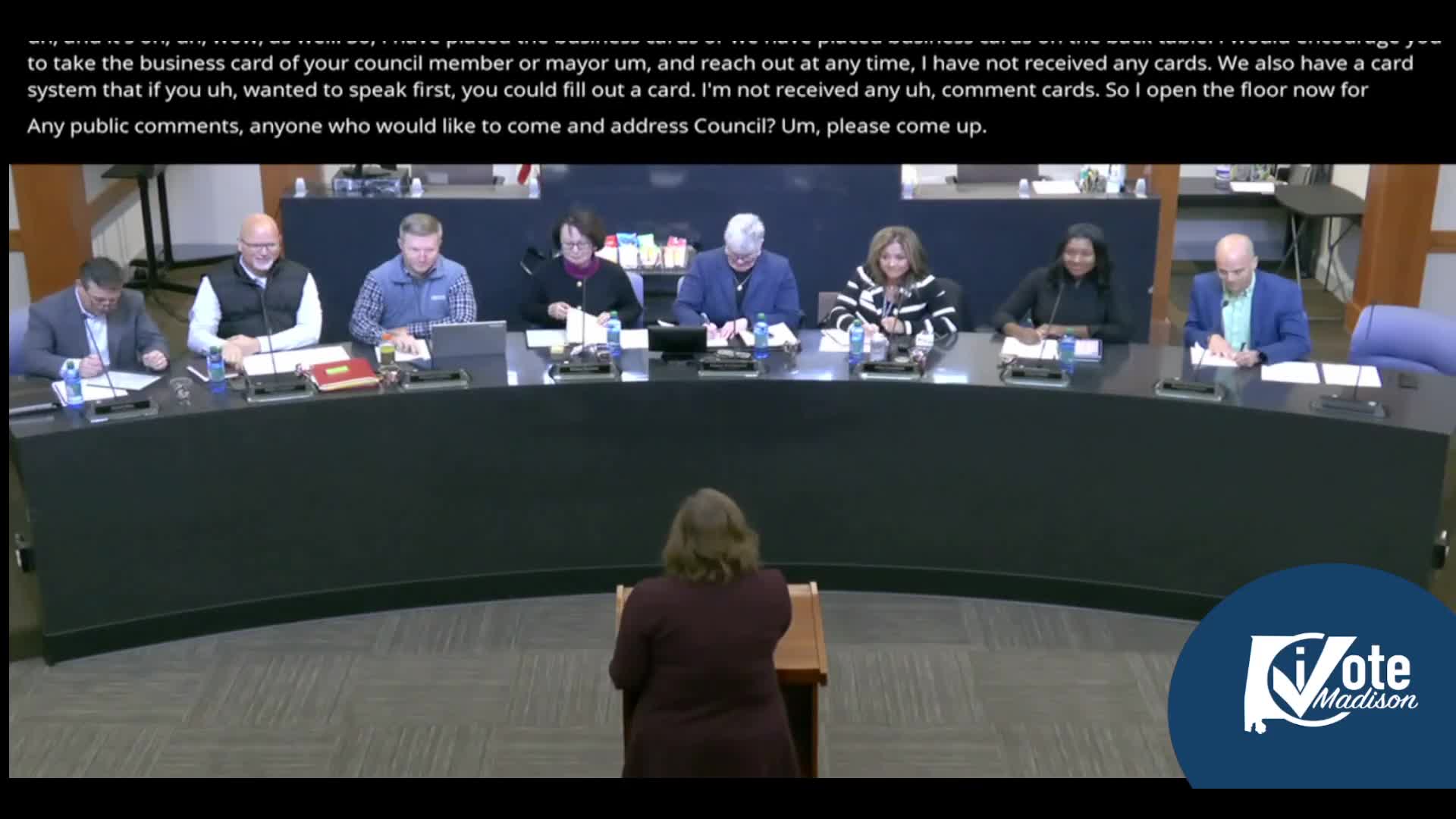
Summary
The council unanimously renewed a 2021 policy and expanded routine live streaming and archiving to include council work sessions; public commenters urged permanent archiving and recording of interviews for major public-facing hires.
Madison City Council voted unanimously Nov. 10 to adopt Resolution 2025-363R, renewing the city's 2021 policy that authorizes live streaming, recording and posting of city council, planning commission and zoning board of adjustment meetings, and formally extending the practice to include city council work sessions.
The measure, presented by the city's legal staff, states work sessions will "be standard operating practice" for live streaming, recording and posting unless a "very sensitive topic is discussed," and instructs staff to record and post meetings when technical problems prevent a live stream. "We are recommending to keep interviews and executive sessions ... may not necessarily be live streamed, to encourage more applications to boards," the legal presenter said (SEG 816-824).
During public comment, Heather Morgan of I Vote Madison said the expansion was welcome but urged stronger measures. "Recording and archiving removes those barriers," Morgan said, arguing the city should (1) record and archive all council work sessions; (2) pursue permanent archiving rather than retention tied to a council term; and (3) reconsider excluding interview meetings for major public-facing positions such as police chief from recording and public access (SEG 167; SEG 174-191). Morgan said consistent access helps residents who cannot attend meetings because of work, caregiving or transportation barriers.
Mayor Renee Bartlett acknowledged Morgan's points and said the council had already broadened the policy to include work sessions; she also said the city will study retention periods with IT and legal before setting a final records-retention schedule (SEG 1116-1122). No amendment to the resolution was proposed during the meeting; council members approved the measure on a unanimous voice and roll-call vote (SEG 843-859).
What it means: The change makes it routine to record and post work-session discussions, which are often where staff and council exchange substantive questions and reasoning behind policy choices. The city has not yet set a permanent retention period; officials said they will evaluate costs and legal considerations with IT and legal before returning to the council with recommendations.
Next steps: The resolution takes effect immediately; legal staff and IT will study retention options and report back to the council on how long archived recordings should be kept and where they will be stored (SEG 1118-1122).