Cayuga County presents tentative 2026 budget, cites rising mandated costs and smaller fund-balance draw
Loading...
Summary
A county official presented Cayuga County's tentative 2026 budget on Sept. 12, 2025, saying the proposal aims to stabilize county finances, reduce reliance on one-time fund-balance draws and protect the county's credit rating.
A county official presented Cayuga County's tentative 2026 budget on Sept. 12, 2025, saying the proposal aims to stabilize county finances, reduce reliance on one-time fund-balance draws and protect the county's credit rating.
"This budget is essentially balanced with $620,000 fund draw from 2026," the presenter said during the presentation, adding that the plan pairs targeted spending reductions with a tax increase to avoid "millions of dollars in unnecessary interest." The presenter read an auditor's paragraph and cited guidance from the New York State Comptroller's Office urging long-term planning to address structural imbalances.
Why it matters: The presentation framed large increases in state- and federally mandated program costs as the central budgetary pressure. The presenter said the county's Medicaid local-share cap is $14.7 million (up from $13 million in 2023) and described Medicaid and other mandated programs as consuming a substantial share of local revenues. "That equates to 49% of our sales tax or 48% of our property tax levy," the presenter said, illustrating the magnitude of the obligation.
Mandatory programs and projections: The presenter highlighted several program-specific increases: - Foster care: local-share costs of about $2.4 million in 2024, $2.5 million in 2025 and a forecasted $3.9 million in 2026, a projected increase of roughly $1.5 million from 2024. - Department of Social Services (DSS): total DSS costs were presented as roughly $21.4 million in 2022 with a projection to about $27.2 million in 2026, a cumulative local-share increase of about $5.7 million (26.6%) since 2022. - Public defender/assigned counsel: local share rose from roughly $904,000 in 2024 to a projected $1.5 million in 2026, in part because of lower reimbursements and statutory assigned-counsel rate increases.
Corrections and probation: The tentative 2026 local-share request for the county jail was presented as $12.2 million. The presenter cited overtime, staffing shortages and new state rules (referred to in the transcript as the HALT Act) as drivers of increased jail costs and said the sheriff had begun hiring part-time deputies to temper overtime expenses.
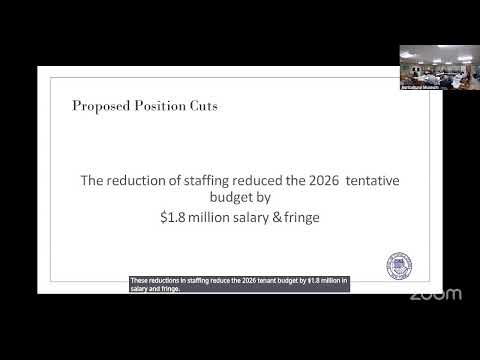
Proposed cuts and personnel: To address the shortfall, the tentative budget would eliminate 22.2 full-time and six part-time positions (the presenter said all but nine of those positions are currently vacant), with the largest reductions in the Department of Social Services and across several operational departments. The presenter said these reductions would lower the 2026 personnel budget by about $1.8 million in salary.
Fund balance and fiscal context: The presenter said the county started this budget process facing an $11.2 million deficit and that without cuts, balancing via property taxes alone would require an untenable increase (the presenter said nearly 25% in one statement). The presenter also reported that the tentative fund-balance draw for 2026 is estimated at $620,000, down from a $5.6 million draw recorded in the prior year.
Audit and Comptroller warnings: Reading from the county auditors' report, the presenter said auditors noted a continuing decline in the county's fund balance and recommended management and the governing board closely monitor budget assumptions and develop a long-term plan. The presenter also said the New York State Comptroller's Office provided an objective assessment of fiscal challenges.
Next steps and procedural note: The presenter announced Ways & Means workshops on the 13th and 18th to continue budget work. Toward the end of the meeting a member identified as "Mark" moved to enter executive session; another member seconded the motion. The transcript records the motion and second but does not record a vote or any subsequent action.
What was not decided: The transcript records only the presentation and the procedural motion to go into executive session; it does not record a final vote to adopt the budget, formal amendments, or any detailed vote tallies on specific cuts.
The county's presentation included numerous program-level figures and slides; the presenter repeatedly emphasized that rising health insurance and retirement costs, reduced state/federal funding for administrative costs and state-mandated program expenses were the main drivers of the county's fiscal strain. Further budget deliberations are scheduled at the announced Ways & Means workshops.