Get Full Government Meeting Transcripts, Videos, & Alerts Forever!
Get email alerts on the Human Trafficking topic
No spam. Unsubscribe anytime.
Goodhue County investigator outlines local human-trafficking and online child-exploitation work
Summary
Investigator Mike Erdman of the Goodhue County Sheriff’s Office described how his unit investigates Internet Crimes Against Children (ICAC) and human-trafficking cases, explained common red flags and sources of tips, and pointed residents to local support groups including Safe Harbor and Hope Coalition.
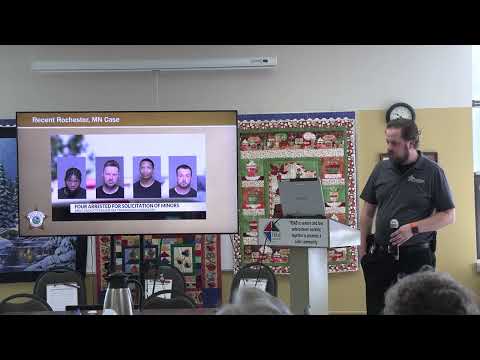
Investigator Mike Erdman of the Goodhue County Sheriff’s Office spoke in Cannon Falls about how his unit investigates human trafficking and online child exploitation, telling residents the office has become more proactive in pursuing cases and now partners with state resources.
Erdman said the office is affiliated with the Bureau of Criminal Apprehension (BCA) Human Trafficking Task Force and now conducts many investigations locally rather than waiting for the BCA to initiate cases. "We are affiliated with their Human Trafficking Task Force with the BCA," Erdman said, describing training that lets local investigators follow leads from tips and online referrals.
Why it matters: Erdman emphasized that trafficking and online exploitation do not occur only in big cities. He described multiple ways investigations start — tips from the National Center for Missing & Exploited Children (NCMEC), website submissions tied to IP addresses, theft reports and routine traffic stops that reveal inconsistencies — and urged residents to report suspicious activity.
How cases begin: Erdman said investigators receive computer-based tips (NCMEC), monitor flagged downloads and run undercover online stings that pose as minors to identify and arrest suspects. He described a sextortion case he investigated in which students were targeted, the suspect was traced across state lines, interviewed and later convicted in state court.
Red flags and community role: Erdman told attendees ordinary citizens play a key role by reporting anomalies — an unfamiliar vehicle in a closed parking lot at night, a minor in a car with an unrelated adult, or a child who suddenly behaves differently. He said theft reports can lead to trafficking discoveries when victims are being directed to steal items for traffickers.
Victim assistance and procedures: Erdman identified local partners the sheriff’s office uses for victim placement and follow-up: Safe Harbor and the Hope Coalition. He said officers can supply victims with hotline numbers or "code" phrases to use for covert requests for help if they fear retaliation from a trafficker.
Age and charges: Erdman said the office treats anyone under 18 as a child for these investigations and has seen cases involving children 10 and younger. He told the audience trafficking charges are felony-level offenses and that prosecutions typically begin at the state level; federal charges are considered case-by-case depending on evidence and other criteria.
Residents’ questions covered parental controls and online safety apps (Erdman mentioned Arc and Bark among commonly used tools) and he cautioned that no app is foolproof since children can use friends’ devices. He closed by inviting attendees to contact him for follow-up information or presentations.
No formal action was taken during the session; the event was an informational presentation followed by audience Q&A.