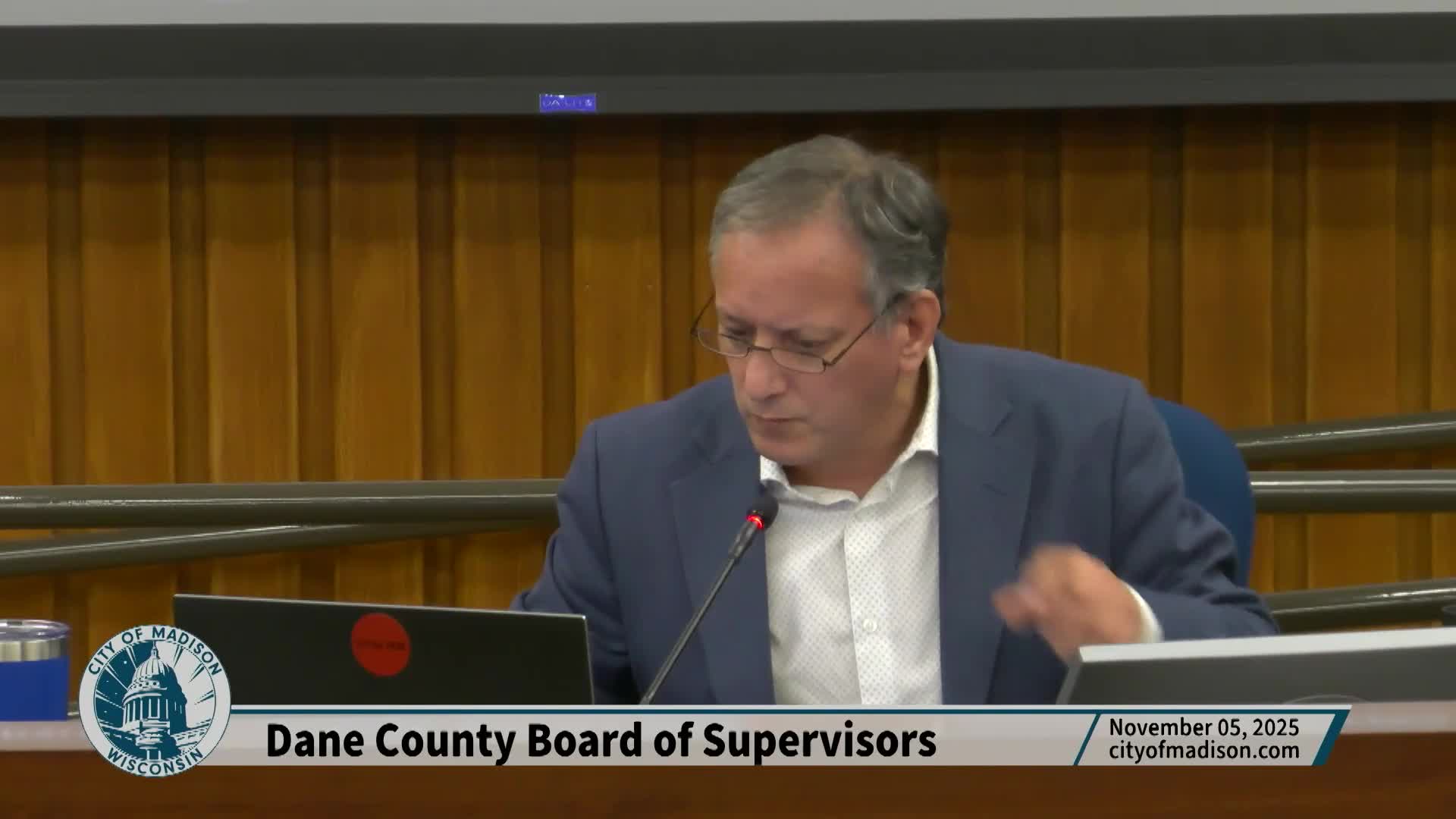
Dane County Board adopts 2026 operating budget after debate over sheriff staffing and human services
Loading...
Summary
After hours of debate over whether to freeze deputy positions or restore funds to human services and shelters, the Dane County Board adopted Resolution 174 (2026 Operating Budget Appropriations, sub 1) on Nov. 5 by roll call, 32–5. Two floor amendments seeking to change staffing and offsets failed in separate roll calls.
The Dane County Board of Supervisors adopted Resolution 174, the 2026 Operating Budget Appropriations (sub 1), on Nov. 5 after extended floor debate over sheriff staffing and cuts to health and human services programs. The board approved the main motion by roll call, 32–5.
Supervisor Peterson moved a floor amendment to reduce the number of frozen deputy positions from 20 to nine and to restore funding to human services. Peterson described the amendment as a pragmatic fix to staffing and overtime pressures and said it would "reinvest $1.58 million into human services priorities," including "roughly $800,000 toward the new men's shelter" and $150,000 for an RFP to plan an overflow shelter. "When those positions remain vacant, their dollars aren't just sitting idle, they're paying for overtime," Peterson said, arguing restored positions would reduce long-term costs and improve public-safety staffing.
That Peterson amendment was defeated in a roll-call vote announced in the record as 1–36.
Shortly after, Supervisor McCarvel moved a separate amendment to restore portions of the sheriff's budget (referred to in the record as the McCarvel or McCarville amendment). McCarvel framed her motion around county staffing data and a $31 million budget shortfall, urging the board to recognize that many municipalities contract with the Dane County Sheriff's Office and would see coverage impacts if deputy positions were frozen.
Sheriff Mike Barrett answered detailed questions from supervisors on the operational meaning of 'vacant' positions and the financial trade-offs of filling vacancies versus paying overtime. Barrett confirmed that vacancies are often backfilled with overtime and that hiring and training timelines are substantial: "The typical hiring process starts anywhere from four to six months," he said, adding that additional academy and on-the-job training follows. He also noted that a federal inmate contract that formerly brought roughly $1.5 million a year in revenue to the county was no longer in place and that revenue for those services now goes to the general fund.
Opponents of the McCarvel amendment argued that restoring sheriff funding would pull money away from purchase-of-service (POS) human-services contracts and jeopardize shelters and community providers already reduced by prior cuts. Supporters of sub 1 said the compromise reflected multiple committee deliberations and an attempt to spread cuts across large departments while preserving critical services like a new Bartillian shelter and an immigration-affairs social worker.
The McCarvel amendment failed on a roll-call vote recorded in the meeting as 6–31. The board then voted on sub 1 (the Personnel & Finance Committee recommendation) and approved it by roll call, the clerk announcing a final tally of 32–5. Chair Miles declared Resolution 174 adopted.
Other business that evening included approval of Resolution 175 (capital appropriations) and Resolution 176 (the 2025 tax levy), along with a package of ordinance fee amendments. The tax-levy discussion featured several supervisors expressing concern about property-tax increases and the county27s structural budget pressures.
With the vote on the operating budget completed, members signaled that the 2027 budget cycle and structural deficit will be immediate priorities for committee work in the coming months. The meeting adjourned after routine closing motions.
The board record shows the key procedural steps and verbatim testimony are on the public transcript for those who wish to review specific speaker exchanges and the clerk27s roll-call tallies. The immediate procedural outcome is the adoption of Resolution 174, sub 1; the policy consequence is that the sub27s funding allocations and position freezes will govern 2026 spending unless altered in later action.