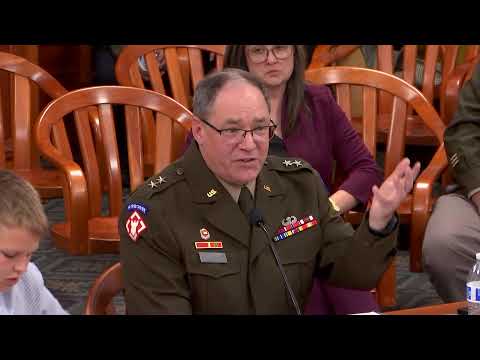
Michigan Guard urges state investment in GPS backup (Project Nitro) and air‑domain awareness to counter drone threats
Loading...
Summary
Adjutant General Paul Rogers told lawmakers Project Nitro could cost about $8.5 million to establish in Michigan plus ~$500,000 per year to maintain; he urged state action to back up GPS timing and build air‑domain awareness to both safeguard critical infrastructure and attract drone manufacturers.
At a Michigan House committee hearing, Adjutant General Paul Rogers warned elected officials that the state's heavy reliance on satellite-based GPS timing creates a vulnerability for critical infrastructure and urged lawmakers to consider state investment in a timing backup called Project Nitro.
"If we wait for the federal resources, we won't see it for years and years," Rogers said, describing Project Nitro as a National Guard timing-assurance pilot that has been demonstrated in 10 states. He told the committee his office estimates an initial Michigan implementation would be about $8.5 million with roughly $500,000 a year for maintenance.
Rogers said nearly 10,000 critical-infrastructure locations across Michigan depend on precise timing for communications, financial transactions and utility operations. "It would be a massive disruption to our quality of life and our ability to function" if timing services were disrupted, he said.
The general pressed for a parallel investment in "air-domain awareness" to track, identify and attribute unmanned aircraft systems (drones). He said the state needs radar and sensor coverage and an operational framework that satisfies Federal Aviation Administration requirements for beyond-visual-line-of-sight operations so commercial uses can scale safely.
Rogers identified state partners who would play roles in such a program: the Office of Future Mobility and Electrification (OFME), the Michigan Economic Development Corporation (MEDC) and MDOT Aeronautics. He said building a reliable tracking and attribution system would not only improve security around airports and critical sites but could make Michigan attractive to manufacturers and operators.
During questioning, Rogers recounted a recent security incident near Camp Grayling in which several People's Republic of China nationals were detected attempting to collect information at a training site; that detection fed into an FBI investigation that, according to Rogers, led to warrants and the subjects fleeing the country. "That was stopped, and they had to flee the country to avoid arrest," he said.
Committee members pressed Rogers on countermeasures and domestic industrial capacity. Rogers said the United States currently lacks the mass-production base for low-cost drones that other countries provide and urged policies to encourage U.S. manufacturing and safe operations. He also noted the challenges of rapidly changing technology: "If you invest a whole bunch of money into one solution, by the time you acquire that and field it, it might be outdated," he said.
The committee did not vote on any funding measures at the hearing. Members and staff signaled an intention to consider these topics further in future oversight and appropriations discussions.
(For clarity: the transcript referenced a Chinese-manufactured drone brand; contemporary public reporting identifies that manufacturer as DJI.)