Get Full Government Meeting Transcripts, Videos, & Alerts Forever!
Get email alerts on the Comprehensive Plan Update topic
No spam. Unsubscribe anytime.
Oviedo LPA Recommends Transmittal of Comprehensive-Plan Update Including Solar, Mobility Changes
Summary
The Oviedo Local Planning Agency voted to recommend transmittal to City Council of an Evaluation and Appraisal Report that adds solar and floating-solar uses, adopts a mobility plan and fee (removing transportation concurrency), extends a green-building deadline to 2029, and updates the future land-use map for several parcels north of SR 419.
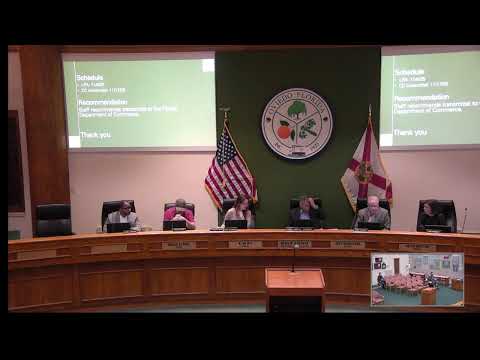
Oviedo planning staff asked the Local Planning Agency on Nov. 4 to recommend transmittal to City Council of Ordinance No. 1760, the city’s Evaluation and Appraisal Report updating the comprehensive plan to reflect changes in Florida law and local policy. “The LPA is asked to recommend transmittal of the ordinance, and this is the evaluation and appraisal report,” planning staff said during the public hearing.
The LPA voted to transmit the ordinance to City Council for its meeting on the 17th after a brief presentation and Q&A, with a voice vote in which all those present said “aye.” The motion to recommend transmittal was made by a board member and seconded; no recorded opposition was noted.
Why it matters: the EAR updates multiple elements of Oviedo’s comprehensive plan to comply with recent statutory changes and to reflect actions the city has already taken. Staff told the board the 2022 comprehensive-plan rewrite met state requirements and set a planning horizon to 2045; Florida requires periodic evaluation, and the EAR recommends targeted amendments across land use, transportation, housing and capital improvements.
Key changes described by staff include new land-use definitions clarifying primary, secondary and other permissible uses under the city’s land-development code; explicit inclusion of solar facilities and floating-solar facilities as permissible uses in certain designations (staff cited state statute language); and amendments to rural, industrial and public future-land-use categories to allow floating solar. Planning staff said the city adopted the state’s definition of solar and floating solar to match statutory requirements and noted floating installations commonly appear in retention ponds owned by state agencies.
In the transportation element, staff said the EAR removes transportation-concurrency language and replaces it with an adopted mobility-plan and mobility-fee framework to encourage movement of people. Staff explained that the city previously signaled adoption of a mobility plan in 2022 and the EAR formalizes that change in the comp plan.
Housing-element changes are limited, staff said, to moving the target date for adopting a green-building ordinance from 2025 to 2029 to avoid imposing more restrictive requirements than state law allows. The capital-improvements element was updated with a new table that retains existing projects and adds new ones based on coordination with parks, public works, fire and other departments; the full table appears in the meeting packet.
The EAR also includes future land-use map amendments for seven parcels numbered 1–7 on the materials. Staff said parcels 1–4 north of SR 419 are city-owned and proposed to change from commercial to public; parcels 5 and 6 are also city-owned and will change to public; parcel 7 is a cemetery property that was annexed in 2023 and requires a city future-land-use designation because it had no prior city designation after annexation. Staff said property owners are aware of the proposed changes.
Board members asked whether the schedule of dates in the plan (items listed from 2025 to 2029) is feasible and sought clarification on what the term “solar facility” encompasses. Planning staff replied the dates are planning targets but the city cannot adopt requirements that are more burdensome than state law allows and that the city is using the state’s definitions for solar and floating solar.
The LPA recommended transmittal to City Council by voice vote and then discussed scheduling: staff noted a possible Nov. 18 work session on the land-development-code “glitch ordinance” and asked members to check availability; members noted planned absences and discussed quorum requirements for a work session. The meeting was adjourned.
What’s next: the LPA recommended that City Council consider transmittal of Ordinance No. 1760 at its meeting on the 17th. The City Council will determine whether to transmit the ordinance (send to review agencies) or take other action as allowed under the transmittal hearing process.