Get Full Government Meeting Transcripts, Videos, & Alerts Forever!
Get email alerts on the Open Meeting Law topic
No spam. Unsubscribe anytime.
Planning & Zoning Commission gets refresher on Arizona open meeting and public records law
Summary
Melissa Henry of the Arizona Ombudsman-Citizens Aide told Prescott Valley's Planning & Zoning Commission that calls to the public are optional, social-media exchanges can create unlawful "meetings," and that, "When in doubt, make a decision in favor of openness," while reviewing notice, minutes, executive session and penalty rules.
Melissa Henry, legal counsel and dispute-resolution specialist with the Arizona Ombudsman-Citizens Aide, told the Prescott Valley Planning & Zoning Commission on May 20 that the state's open meeting and public records laws exist to "maximize access to the process" and "promote transparency and accountability." The training covered how the law defines meetings, notice and agenda requirements, public rights, executive sessions, and potential penalties for violations.
Henry said the Ombudsman's office handles complaints and provides training but does not give legal advice: "We do not give legal advice," she told commissioners, adding that the office's updated video and booklet are available as training resources. She introduced her colleague Nick Bacon, another attorney in the office, who recommended routine "courtesy" notices when a quorum will attend external events to reduce appearance-of-impropriety complaints.
The presentation clarified when a gathering becomes a "meeting" under Arizona law: a quorum of the body plus discussion, deliberation or a proposal to take legal action. Henry warned that serial communications, one-way electronic proposals and interactive social-media exchanges among a quorum can constitute a meeting subject to notice requirements. "You can fall into a meeting inadvertently," she said, urging caution when members respond substantively to staff emails or posts.
On public participation, Henry said calls to the public are optional: a governing body may include a public comment period on the agenda but is not required to do so. If a call to the public is held, speakers may address matters within the commission's jurisdiction and the body may impose reasonable time, place and manner restrictions, such as limiting speakers to five minutes or asking a group to appoint a spokesperson. Henry emphasized that commissioners generally cannot engage in discussion of non-agenda matters during the call and can only take limited actions afterward (for example, asking staff to study an issue or placing it on a future agenda).
Town attorney Ivan Legler, serving as co-counsel in the meeting, reminded commissioners that statutory public hearings (for zoning matters) are distinct from optional calls to the public and generally give the public a right to speak; he said some jurisdictions ask commenters to hold questions for the hearing to avoid duplication.
Henry reviewed notice and minutes requirements: a disclosure statement telling the public where meeting notices are posted, a meeting notice made available at least 24 hours in advance (with certain counting rules for physical postings), and either minutes or a recording made available within three working days after the meeting. She advised including enough detail on agendas so the public understands what will be discussed and cautioned that items not on the agenda generally cannot be discussed until placed on a future agenda.
The training addressed executive sessions: they must be listed on the agenda with a specific statutory reason and description, require a vote to convene, exclude the public, permit only specified confidential topics (for example, attorney consultation or exempt records), and do not authorize final legal action while in session. Henry noted that executive-session minutes must be kept but remain confidential.
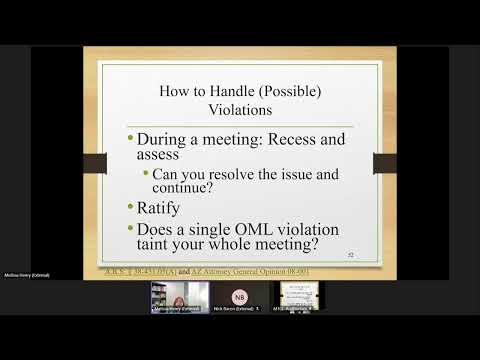
Henry warned about the consequences of violating the open meeting law: actions taken in violation may be null and void, and individuals who knowingly violate the law can face civil penalties and potentially removal from office. She cited civil penalties discussed in the presentation and said such personal penalties may escalate with repeated violations. "When in doubt, make a decision in favor of openness," Henry advised as a closing principle.
The commission asked several procedural questions about defining "disruptive" conduct, handling repeated speakers, and whether a board can remove a call to the public from future agendas; Henry repeatedly recommended consulting the town attorney for formal policy language and said the Ombudsman office is available as a resource. The session closed after commissioners thanked the presenters; no votes or formal actions were taken at the special training session.