Consultants outline vision, strategic sites and contamination concerns for Middletown Community Campus BOA study
Loading...
Summary
Hudson Valley Pattern for Progress presented findings from its Middletown Community Campus Brownfield Opportunity Area study, highlighting a community vision, 10 strategic sites (including a former power plant and the Kleiner Building), preliminary environmental flags and next steps for public workshops and site testing.
Hudson Valley Pattern for Progress consultant Kate Stryker presented the second public meeting on the Middletown Community Campus Brownfield Opportunity Area (BOA) study, outlining a community vision, survey findings and 10 strategic sites that the project team will evaluate for cleanup and redevelopment.
"The Middletown Community Campus is a vibrant and inclusive space that serves as a central hub for education, innovation, culture, the arts, commerce and outdoor recreation," Stryker said, reading the vision that will guide planning and developer alignment under the BOA process.
Stryker said the study—funded through the state's Brownfield Opportunity Area Planning Program and managed in part by Susan Landfried of the New York State Department of State—aims to produce a community-led plan, development concepts for strategic sites, and policy recommendations to support cleanup and future investment. A BOA designation would make sites eligible for certain state subsidies and tax credits, she said, which can lower remediation costs and make redevelopment more feasible.
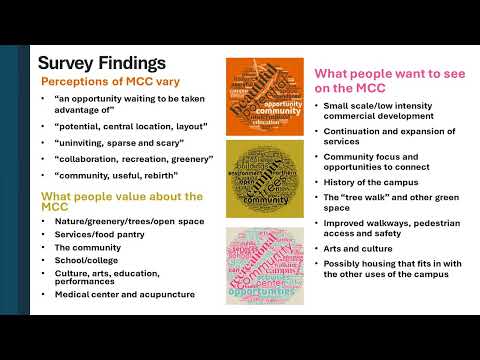
Survey and focus-meeting results presented by Stryker showed mixed perceptions of the campus: many respondents highlighted nature, greenery and arts programming as top values, while others described parts of the campus as "uninviting" or "scary." The community expressed a preference for small-scale, lower-intensity commercial uses and preservation of green space, with interest in improved walkways, lighting, parking and restroom facilities to support events and programs.
The team flagged several sites for further environmental review. Stryker said the project has used a 2015 Phase I environmental assessment of state-owned properties (completed before those properties were transferred to the city) and a 1997 building survey to create an initial map of potential issues. Sites of concern include a former commercial laundromat on Monhagen Avenue, a former welding shop, the Kleiner Building, the 54 Building (a former nurse's residency) and a former power plant with a tall smokestack that Stryker described as "most likely" a brownfield.
Community members raised practical reuse ideas and cautions during the question-and-answer period. An attendee suggested salvaging the metal in the power plant as a revenue source; Stryker said it was "an interesting idea to be investigated." Noni Kelly, who said she ran the Klein RI Center for about 20 years, urged rehabilitation of the Kleiner Building for intergenerational programming and praised the initiative.
On funding for Kleiner, participants and staff clarified numbers during the meeting: Stryker said the city has received a state grant of $6,000,000 to rehabilitate the Kleiner Building; the mayor later clarified additional committed grants totaling $3,300,000 and said preliminary rehabilitation cost estimates for the full building are in the $30 million to $35 million range. The presentation noted that further engineering and testing will be required to refine cost estimates and remediation scope.
Transportation and public-safety questions were also raised. On parking near the Kleiner and Tuckerman Hall sites, Stryker said the city plans a campus transportation study to assess parking and access as site concepts are developed. Mayor DeStefano said two buildings near the former power plant will house Middletown fire and police presence, including an evidence facility and staffing "not 24/7," which the mayor said will increase on-campus public-safety presence.
Stryker said the BOA boundary was deliberately extended to improve connectivity with a planned Heritage/rail trail and reservoir trails; steering-committee members working on county rail-trail planning described a routing through downtown, across Monhagen and onto the campus that would connect to the reservoir trail network.
Next steps outlined by the consultant include phase-2 public workshops, site tours and more focused community design sessions through May, followed by preparation and submission of a BOA nomination to the state (aiming for the end of next year). Stryker invited attendees to sign the project email list for notices about tours and upcoming meetings.
No formal votes or policy decisions were taken at the meeting; the presentation closed with public questions and a commitment to more testing and outreach before project recommendations are finalized.