
Carver County board adopts 2026 legislative priorities after debate over transit opt-out and housing language
Get AI-powered insights, summaries, and transcripts
Subscribe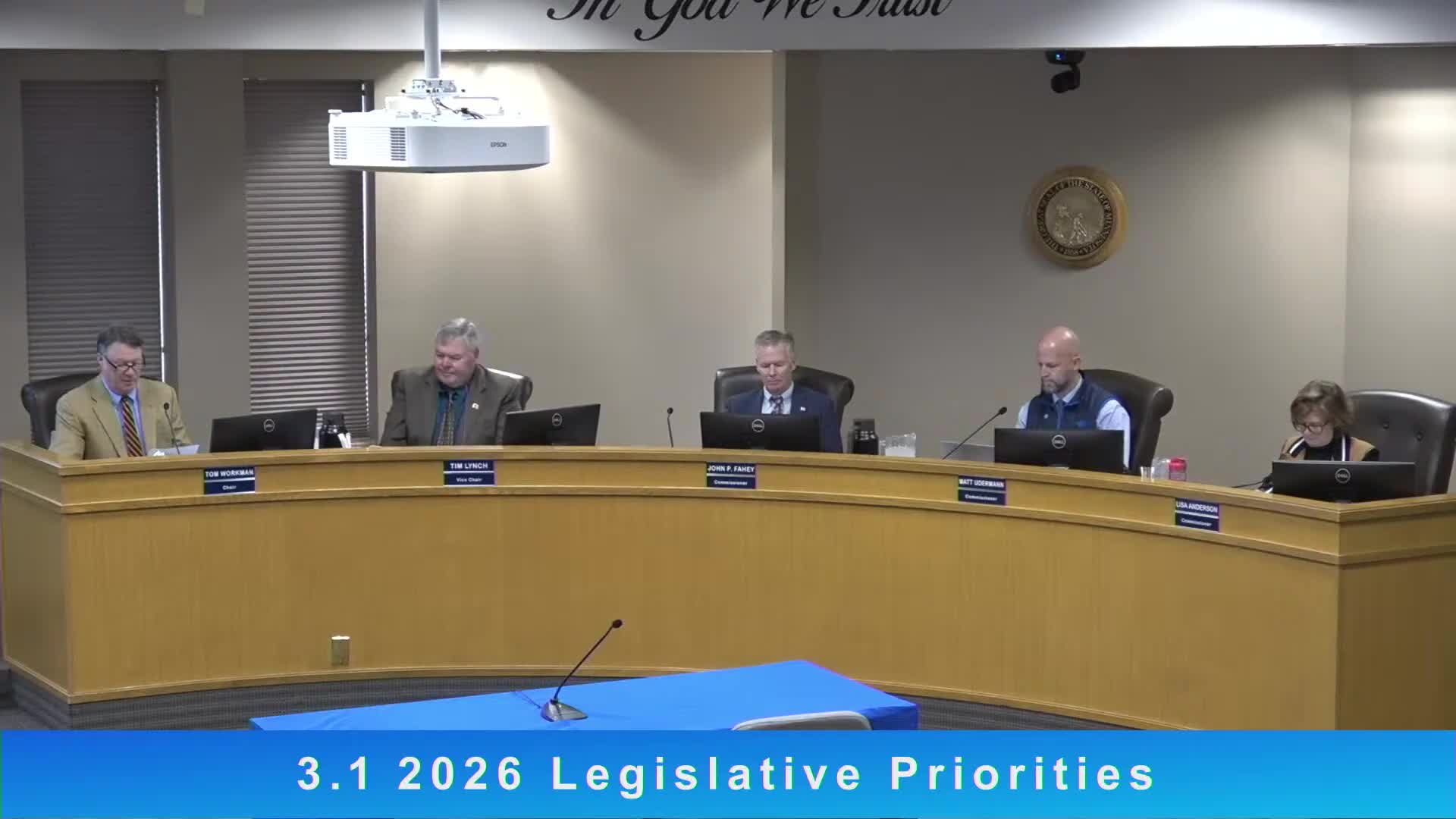
Summary
The Carver County Board voted Nov. 4 to adopt a 12-item package of 2026 legislative priorities that includes language defending local 'opt-out' transit agencies and new, broadly worded housing support. The action passed by voice vote after extended debate over process and scope.
CHASKA, Minn. — The Carver County Board of Commissioners on Nov. 4 adopted its 2026 legislative priorities, including a formal position opposing state efforts to eliminate local transit 'opt-out' agencies and newly added housing language, after an extended debate about process and scope.
County administrator Hemsey presented the priorities and urged a concise list focused on the county’s most pressing concerns, saying the board’s work this year centered on defending against "unfunded state mandates" and proposed shifts that could increase property taxes. Hemsey told commissioners the county is coordinating with other metro counties and the Association of Minnesota Counties as it prepares for the legislative session.
The board added explicit language opposing proposals to fold opt-out transit agencies into the Met Council’s system and asked the legislature to preserve the existing model for agencies such as Southwest Transit. "We're asking that the legislature preserves that transit model, oppose any proposal that would eliminate agencies such as Southwest Transit," Hemsey said during the discussion.
Commissioners also debated whether to add housing as a formal priority. Commissioner Workman offered draft language emphasizing state assistance and funding to "increase production of residential units, the preservation of existing homes, and housing stability programs," while preserving local control. Workman framed the item as a coalition-building step with neighboring jurisdictions and said the language was similar to last year’s priority.
Not all commissioners supported adding housing. Commissioner Anderson said she was uncertain the proposed paragraph would give a legislator clear direction. "If I looked at this, I am uncertain if I had a piece of housing legislation, what this would support," Anderson said, arguing the language was not specific enough to translate into policy. She nevertheless moved to adopt the package including the opt-out language; Commissioner Fahey seconded the motion.
Commissioner Uterman and others pressed that any housing position should be developed in coordination with city partners and the county legislative committee; Uterman said the cities "are putting this on their legislative priorities" and urged more collaboration. Supporters argued adopting similar language to 2025 would enable coalition-building and give Carver a seat at the table as state work unfolds.
The meeting also included questions about county capital projects and cost-sharing with the state. Commissioners discussed a Highway 212 soils remediation where MnDOT offered up to $3 million for fixes and the county, as project lead, negotiated shared costs after state direction to pursue full excavation. County staff said there could be penalties for delay on park construction projects but that the Minnewaska regional park project was running under budget and had a surplus to roll into other priorities.
The board approved the legislative priorities package by voice vote; the chair noted there were no opposing voices when members were asked to say "aye." Staff said the county will finalize the priorities packet and host a legislative breakfast tentatively set for Dec. 16 at the American Legion to present the priorities to state lawmakers and continue individual legislator outreach ahead of the 2026 session.
Votes at a glance: The board approved a motion to adopt the 12 legislative priorities, including the added opt-out transit position and the housing language as presented; motion moved by Commissioner Anderson and seconded by Commissioner Fahey; outcome: approved by voice vote.
Next steps: Staff will finalize the packet, distribute it to legislators and hold a legislative breakfast in December; additional meetings with individual legislators are scheduled ahead of the Feb. 2026 session.