
CartwheelCare tells Georgia committee virtual mental-health services can cut chronic absenteeism; urges funding for elementary schools
Get AI-powered insights, summaries, and transcripts
Sign Up Free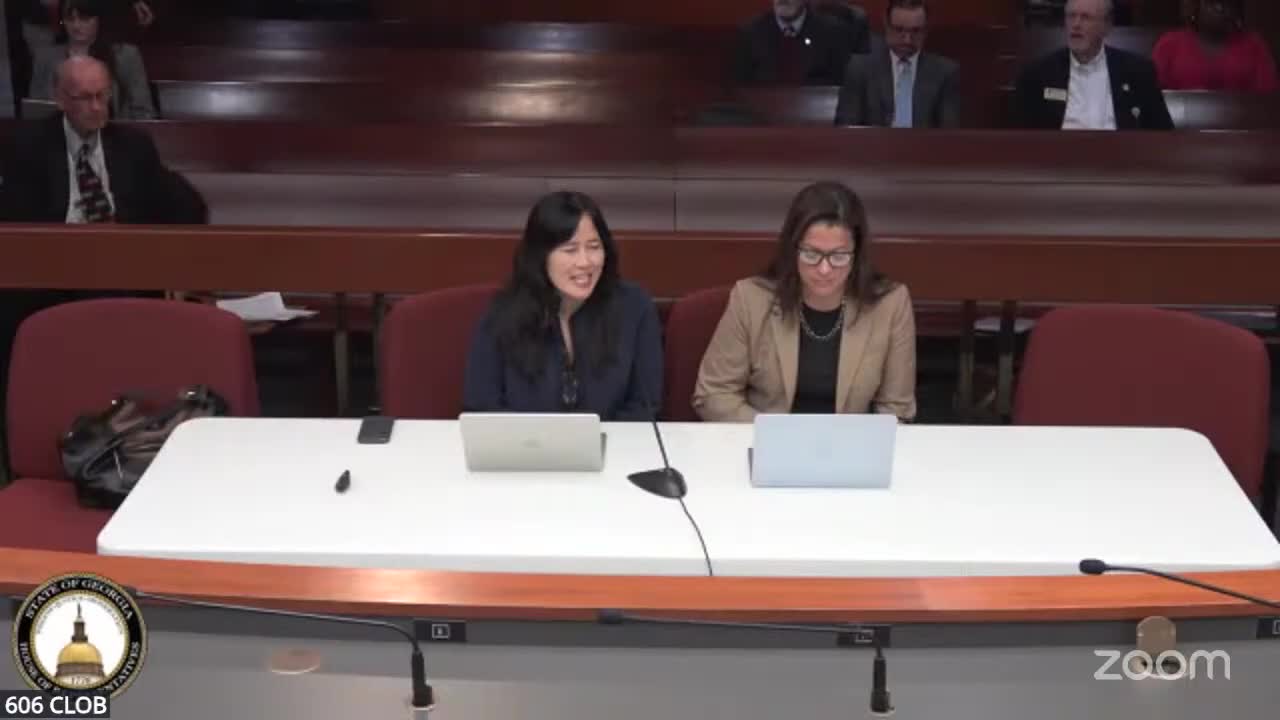
Summary
CartwheelCare told the Student Attendance & Chronic Absenteeism Study Committee that addressing youth mental health through school–community telehealth partnerships can reduce chronic absenteeism and urged the legislature to extend a $20,000-per-school investment to elementary schools.
CartwheelCare told the Student Attendance & Chronic Absenteeism Study Committee that addressing youth mental health through school–community partnerships — including virtual care — is essential to reducing chronic absenteeism. "Roughly 1 in 5 Georgia students is chronically absent," Dr. Juliana Chen, CartwheelCare’s chief medical officer, told the committee, "this equals over 360,000 children across the state." She said anxiety and other mental-health challenges are primary drivers of school avoidance and long-term absentee patterns.
Dr. Juliana Chen and Jillian Kelton, Cartwheel’s director of district engagement, described a braided funding model that combines insurance billing with district support and financial-aid funds to cover uninsured students. Kelton said Cartwheel serves more than 325 districts nationally and cited program outcomes: "92 percent of students show improvement in their mental health," and schools report a "44 percent decline in absenteeism among students who receive care," she said. Cartwheel also presented an anonymized case example of a tenth grader who missed 25 days and returned to regular attendance after virtual therapy and parent guidance.
The presenters said Georgia’s legislative investment currently funds services in public middle and high schools and asked the committee to expand the $20,000-per-school appropriation so it applies to elementary schools as well. "We’re here to urge the committee to continue to expand the $20,000 per school investment in direct mental health services to include elementary schools," Dr. Chen said, arguing early identification and intervention can prevent escalation of absenteeism.
Committee members pressed for operational details. Seth Ryle, Cartwheel’s director of government affairs, said Georgia uses an "unlimited referral" model in which districts can refer as many students as needed and that per-student counts vary by district size. In a hypothetical district receiving $60,000 (three schools), Ryle estimated Cartwheel could serve roughly 75–100 students in a year and track changes in attendance, behavior and suspension rates.
Vice Chair Rice asked how care follows students who move districts or transfer to schools without a Cartwheel partnership. Kelton and Chen said their portal supports warm handoffs, that "care follows the student" with parent consent, and that information-sharing is handled in compliance with FERPA and HIPAA.
Cartwheel committed to providing Georgia-specific estimates and outcome data as more districts sign up. Committee members asked the Department of Education to provide county-by-county comparisons and staffing data to help evaluate which districts could benefit most from expanded elementary funding. The meeting closed with the committee requesting follow-up materials and data from both Cartwheel and state education staff.