Get Full Government Meeting Transcripts, Videos, & Alerts Forever!
Get email alerts on the Environment Regulation topic
No spam. Unsubscribe anytime.
MassDEP staff outlines COM 24 proposal to limit imported contaminated soil with site-specific caps
Summary
A MassDEP presenter proposed COM 24 acceptance criteria requiring donor- and receiving-site characterization, prohibiting hazardous wastes and certain contaminants, and applying site-specific caps on mean and maximum concentrations with suggested numeric placeholders from the MCP.
A Massachusetts Department of Environmental Protection (MassDEP) staff member outlined a proposal for COM 24 acceptance criteria for sites that would accept imported soil, saying the approach is preliminary and subject to change.
The presenter said the program would exclude receiving locations in GWN areas to avoid "material leaching out of the soil and threatening or contaminating drinking water," and would limit volatile organic compounds, particularly chlorinated VOCs, to reduce vapor-intrusion and groundwater risks. The proposal also would bar imported soil containing significant solid waste, PCBs, asbestos or hazardous waste because those materials could create health risks or trigger other regulatory programs, including NESHAPS or TSCA.
Under the proposal, receiving sites must already be well characterized and part of 21 eSight, and must have achieved or be set up to achieve a permanent solution under the Massachusetts Contingency Plan (MCP) that covers both on-site soil and any imported material. Donor sites would likewise need characterization equivalent to MCP standards before excavation; in contrast to COM 15, truck sampling would be "merely confirmatory samples to show that this truck coming from that donor location is consistent with what we already know about the soil at the donor location."
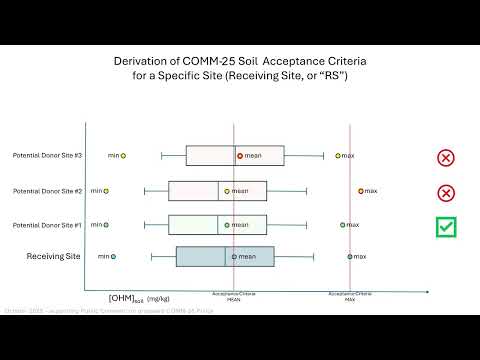
The core acceptance principle would be that "the soil that's being imported cannot be worse than what's already there" — it must be similar to or better than the receiving-location soils. To prevent very contaminated material being imported simply because the receiving site already contains gross contamination, the presenter proposed two caps applied regardless of receiving-site levels: one cap on the mean concentration of a contaminant and one cap on the maximum concentration.
Using box-and-whisker comparisons of contaminant distributions, the proposal would compare donor-site mean and maximum concentrations to the receiving-site mean and maximum. The presenter illustrated three examples: (1) both donor mean and maximum below the receiving criteria (acceptable); (2) donor mean acceptable but donor maximum exceeds the receiving maximum (rejected); and (3) donor maximum acceptable but donor mean slightly above the receiving mean (rejected). The presenter emphasized these determinations should be made before trucks start rolling.
For highly contaminated receiving sites, the two-cap system would take effect so that acceptance criteria do not simply mirror gross contamination already present. The presentation proposed that the COM 24 policy include an appendix with a table to guide users through determining site-specific acceptance criteria. The table would list chemicals, include standard values drawn from the MCP in columns C and D, and leave columns A and B for proponents to enter donor-site mean and maximum concentrations. The acceptance criteria for mean and maximum would be the lower of the relevant donor/receptor values and the MCP-based caps.
As placeholders, the presenter suggested a cap on the mean equal to "2 times the Method 2 direct contact concentrations" and a cap on the maximum equal to the "Method 3 ceiling limit," while inviting alternatives. Proponents would be required to submit a proposed acceptance-criteria table as part of the application package; the final COM 24 policy would include an appendix template and guidance.
The presenter characterized the proposal as draft and open to suggestions, noting implementation details and numeric values are subject to revision.