
UN leaders hail adoption of Doha political declaration, push for implementation and financing
Get AI-powered insights, summaries, and transcripts
Subscribe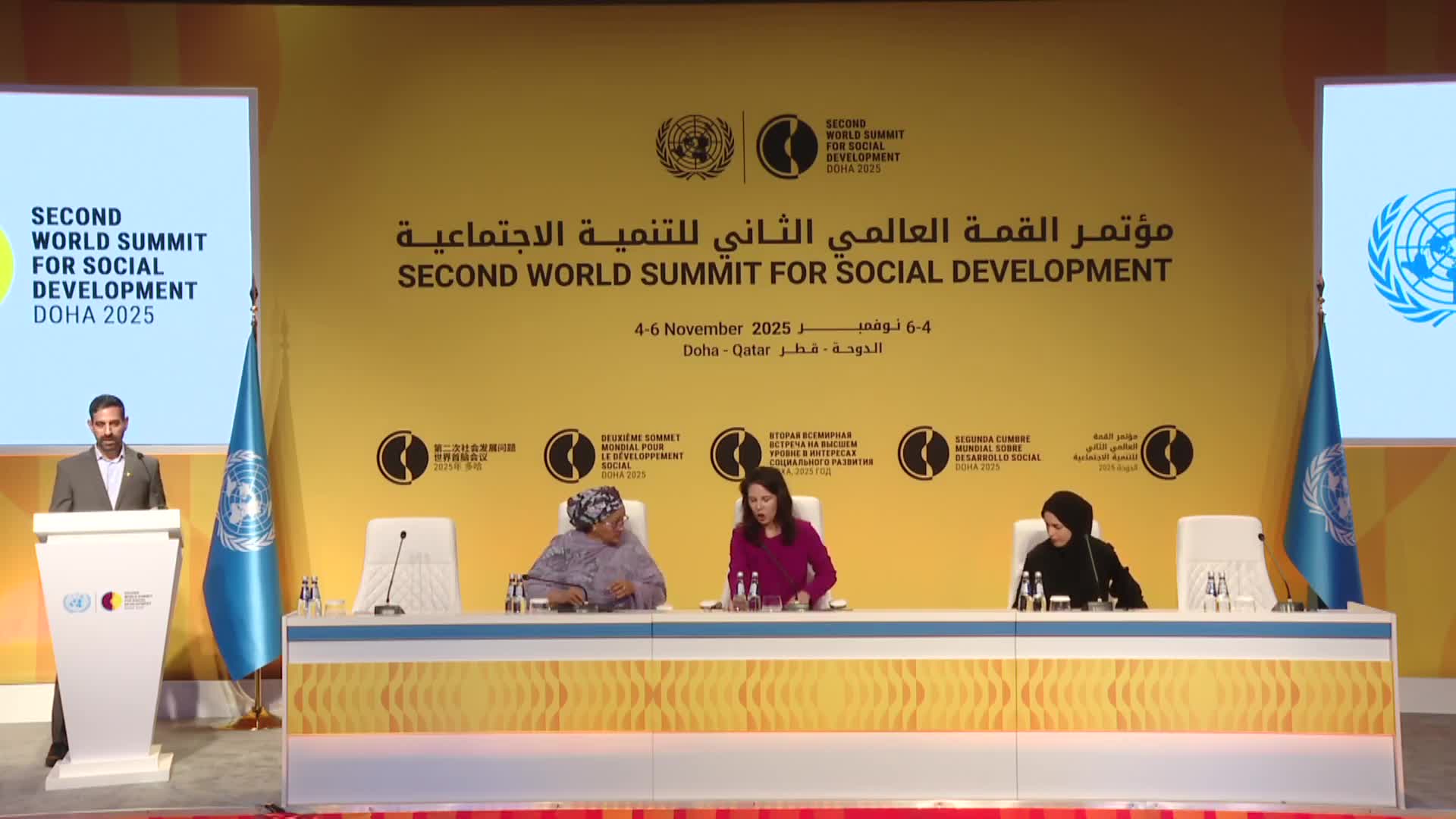
Summary
At a closing press conference in Doha, UN officials said the World Summit for Social Development adopted the Doha political declaration and urged a shift from pledges to implementation, calling for a reformed global financial architecture and renewed focus on social protection, gender equality and climate‑sensitive policies.
Doha — Leaders at the closing press conference of the second World Summit for Social Development on Friday said member states adopted the Doha political declaration and pledged to move from agreement to action on poverty, inequality and social exclusion.
"This summit marks a deliberate shift from looking at the problem to acting on proven solutions and learning from each other," said Annalena Baerbock, president of the 80th session of the United Nations General Assembly, calling for a global financial architecture "fit for the 21st century" to address debt burdens and unlock international financing.
The summit, held over three days in Doha, brought more than 40 heads of state and government, some 230 ministers and about 8,000 participants, organizers said. Delegates and civil‑society representatives advanced a package of priorities in the Doha political declaration emphasizing universal, gender‑responsive social protection, equitable access to health and education, decent work and social inclusion as central to the 2030 Agenda for Sustainable Development.
"It is not a document for the shelves," said United Nations Deputy Secretary‑General Amina Mohammed, describing the declaration as "a people's plan" that must be followed by concrete implementation: accelerating efforts to tackle poverty and inequality, building real jobs and opportunities, and ensuring no one is left behind.
Speakers at the press conference tied social development to climate action, arguing that the climate crisis is one of the largest obstacles to reducing poverty. Baerbock said peace, security and climate resilience are essential complements to social policy.
Qatar, which hosted the summit, said it will continue to support social development through bilateral and multilateral financing. Sheikha Aliyah bin Saif Al Thani, permanent representative of the State of Qatar to the United Nations, said that "from 2022 to 2024, we have provided over $4.8 billion in foreign aid," citing roughly $1 billion for poverty and hunger, $1 billion for education, health, water and clean energy, and about $1 billion in special drawing rights to IMF funds dedicated to poverty reduction and resilience.
Organizers highlighted the summit's emphasis on practical, scalable solutions and partnerships with civil society, business and philanthropic partners. The delegation credited co‑facilitators Morocco and Belgium for enabling consensus‑based negotiations.
Before opening the floor to questions, UN staff announced the launch of a Spotlight Initiative report with the Deputy Secretary‑General and flagged that COP30 will begin in Belém, Brazil, with the UN secretary‑general scheduled to speak at its opening session.
The press conference closed with leaders and UN officials urging member states and partners to translate the Doha political declaration into national policies and funding commitments, and to pursue implementation ahead of the 2030 deadline.