
Utah Supreme Court hears appeal from immigration attorney Elle Cox over missed filings and sanctions
Get AI-powered insights, summaries, and transcripts
Subscribe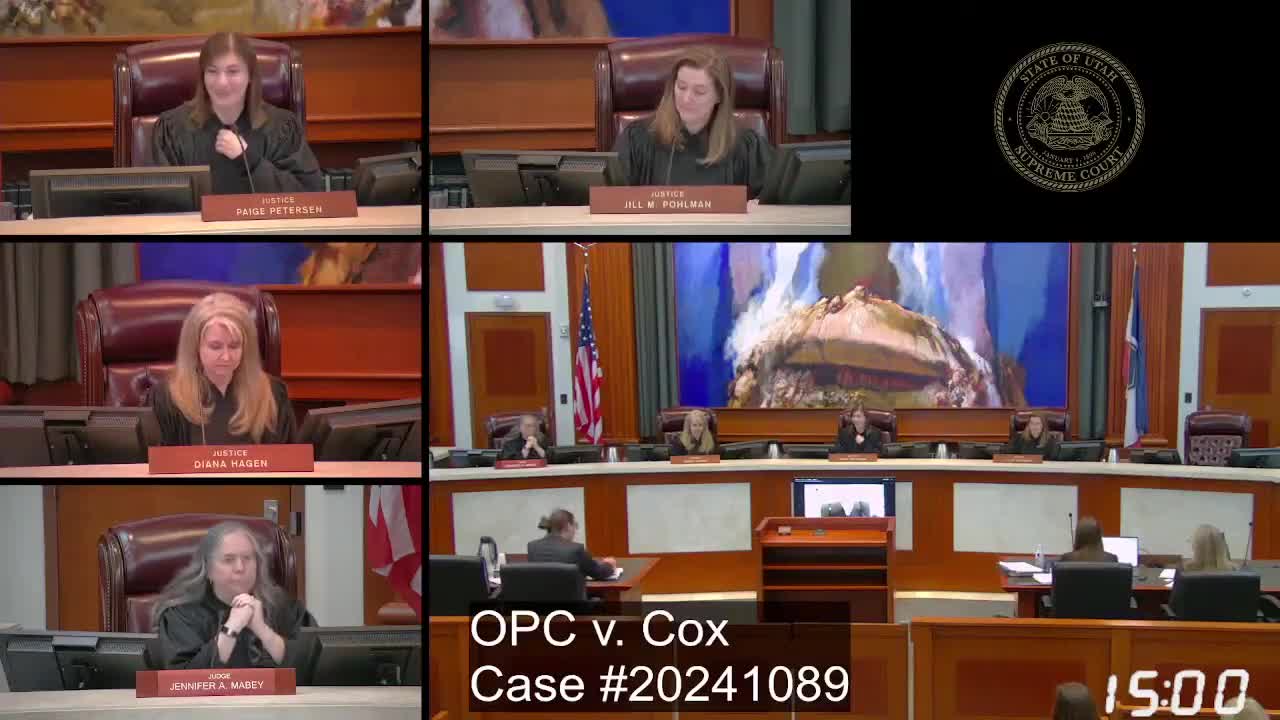
Summary
The Utah Supreme Court on oral argument heard an appeal by immigration attorney Elle Cox, who urged the justices to reverse disciplinary findings that she violated Utah professional-conduct rules by missing a filing deadline and demonstrating incompetence in a client's immigration matter.
The Utah Supreme Court on oral argument heard an appeal by immigration attorney Elle Cox, who urged the justices to reverse disciplinary findings that she violated Utah professional-conduct rules by missing a filing deadline and demonstrating incompetence in a client's immigration matter.
Cox, appearing pro se, told the court she “protected the client's interest” by prioritizing negotiation with ICE during the government and court shutdown in early 2019 rather than mailing documents she feared would be ignored. She said her choices reflected immigration practice realities—what she called “triage”—and argued the disruptions and frequent changes in ICE counsel made timely filing impracticable.
“The court shut down,” Cox told the justices, and she said she repeatedly tried to identify and reach opposing ICE counsel so she could obtain discretionary relief for her client; she said that negotiation, not immediate filing, was necessary to preserve the client’s ability to stay in the United States.
Counsel for the Office of Professional Conduct pushed back. OPC argued Cox’s appellate briefing failed to meet procedural rules and often lacked record citations, and that the underlying record nonetheless supports the district court’s findings. “She has failed to adequately brief her arguments,” OPC counsel told the court, noting the administrative screening materials do not always transfer into the district-court record but that the trial testimony and exhibits provide evidence supporting violations of rules 1.1 (competence) and 1.3 (diligence).
A central dispute at argument was timing and notice: whether the screening panel added a 1.1 competence charge only after initial notices and, if so, whether Cox had adequate notice before the screening-panel hearing. OPC told the court it had added rule 1.1 to the memorandum it sent to Cox and the panel at least 14 days before the panel hearing. The justices also discussed whether certain district-court subfindings impermissibly relied on an immigration judge’s March 2019 order as hearsay or whether the district court independently had sufficient evidence.
The justices examined sanction gravity and mens rea definitions, asking whether the record showed a “substantial pattern of neglect” or a knowing failure to perform significant services for a client. OPC said the pattern in the record—last-minute filings, filings with weak substance, failure to keep mailing proof, calendaring errors, and the resulting client injury (including an order of removal and later retention of another attorney to fix the issue)—supports suspension-level discipline rather than a lesser sanction.
Argument also touched on a counseling condition in the sanction. The court asked how confidentiality and compliance are handled when mental-health counseling is a probation term. OPC said bar-provided counseling (referred to during the hearing) is commonly used, and courts typically accept confirmation letters from therapists verifying attendance without requiring session details.
Cox closed by reiterating that her efforts to coordinate with ICE were central to her strategy and arguing the district court and OPC misunderstood immigration practice norms. The justices took the matter under advisement and recessed.
What happens next: the Utah Supreme Court did not announce a decision at the argument; it said it would consider the briefing and argument and issue an opinion in due course.