Get Full Government Meeting Transcripts, Videos, & Alerts Forever!
Get email alerts on the On Site Wastewater Taskforce topic
No spam. Unsubscribe anytime.
Maricopa County board accepts 27 recommendations to streamline septic permitting, asks staff to implement
Summary
The Maricopa County Board of Supervisors unanimously accepted a report from an ad hoc stakeholder task force that proposed 27 recommendations to clarify permitting, adopt virtual reinspections and push ADEQ to update on-site wastewater rules; the board directed staff to implement the recommendations and to report back on performance metrics.
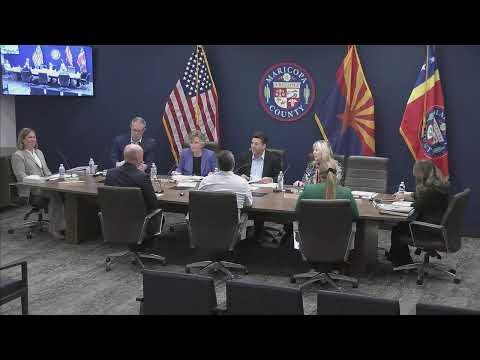
The Maricopa County Board of Supervisors on Nov. 3 unanimously accepted a stakeholder task force report that lays out 27 recommendations to improve the county—s on-site wastewater (septic) permitting and inspection process, and directed county staff to proceed with implementation.
The board session featured a presentation from Andy Linton, director of the Maricopa County Environmental Services Department (MCESD), and David Pounders, a professional engineer and chair of the ad hoc task force formed at the board—s direction. Linton said the county convened stakeholders beginning with a July 31 kickoff and reached consensus on the recommendations after meetings through Oct. 10. "We had a kickoff meeting on July 31, and the task force identified some areas for improvement," Linton said during the meeting.
The report groups improvements across seven major areas and includes both county-level process changes and requests the board take state-level action. Pounders told the board the recommendations are intended to produce clearer, more consistent reviews and reduce unnecessary review cycles. "We want the Water Works Bulletin to play a little bit more active role within the community," Pounders said, describing the bulletin as a vehicle for communicating common mistakes and reviewer expectations.
Major county-level recommendations the task force highlighted include:
- Clarify MCESD staff interpretations and publish checklists and procedures so applicants know what reviewers expect, including clearer guidance on accepting certificates of completion via the Water Works Bulletin.
- Use the publicly available Arizona Department of Environmental Quality (ADEQ) Alluvial basin GIS map (or have ADEQ add the county—s additional layer) instead of relying on a nonpublic internal soils map that has caused confusion for applicants.
- Permit-process changes for subdivisions: rely on thorough geotechnical reports for area-level screening while reserving site-specific testing for individual lots, reducing duplicated preliminary testing.
- Require annotated hold letters with resubmissions to focus review on previously identified issues and limit new, unexpected reviewer comments.
- Allow virtual reinspections for minor items (photos/video) to shorten homeowner delays and reduce inspector travel time; the task force also recommended additional staff training on newer alternative septic technologies.
Pounders and Linton also urged the board to send a letter to ADEQ requesting prioritized rulemaking and targeted statutory changes. Pounders described three state-level priorities for that letter: giving counties more leeway on reserve-area requirements for older parcels, clarifying parameters that jurisdictions use to determine sewer availability (which can vary, for example, between 300 and 500 feet), and creating a statutory mechanism to extend expired septic construction approvals. "There—s no way by statute to extend a sewer septic permit that has been expired," Pounders said, and added that stakeholders and ADEQ agree a mechanism should exist.
Board members sought assurances that changes would not reduce system safety. Supervisor Lesko asked if the recommended changes would keep systems safe; Linton said the stakeholder group included engineers, installers and developers and that MCESD subject-matter experts concurred the recommendations would maintain public-health protections while improving customer service. "We will be measuring that," Linton said when asked whether staff would track faster inspection times resulting from virtual reinspections, noting staff expects the change to help reach a 1-to-2-day inspection window for reinspections.
Linton said MCESD has been coordinating with ADEQ and that ADEQ has included on-site wastewater rules in its strategic plan to reopen rulemaking. When asked whether rule changes would require legislative action, staff clarified that the changes proposed are administrative (Arizona Administrative Code) and would be addressed through ADEQ rulemaking rather than the state legislature.
After the presentation and questions, the board considered a motion by the vice chair to "accept the report from the Maricopa County Environmental Services on-site wastewater ad hoc stakeholder task force and direct staff to proceed with implementation of the recommendations as contained in the report." Supervisor Stewart seconded the motion. Chairman Galvin called for the vote and the motion carried unanimously among those present.
The meeting concluded with the board moving into executive session immediately following the informal meeting.
What happens next: Staff will begin implementing the county-level process recommendations and said it will measure and report back on changes such as inspection turnaround times; the board also will prepare a letter to ADEQ supporting prioritized revision of on-site wastewater rules and seeking the specific statutory and interpretive changes recommended by the task force.
Sources: Presentation and Q&A at the Nov. 3, 2025 Maricopa County Board of Supervisors informal meeting; comments by Andy Linton, director, Maricopa County Environmental Services Department, and David Pounders, task force chair.