Get Full Government Meeting Transcripts, Videos, & Alerts Forever!
Get email alerts on the Land Development Code topic
No spam. Unsubscribe anytime.
Palm Coast proposes LDC updates to boost connectivity and clarify parking rules
Summary
City staff proposed changes to Chapter 5 of the Land Development Code including expanded micromobility language, higher thresholds for additional subdivision access points, wider multi-use trails, clarified sidewalk in-lieu fees (about $55/linear foot), and parking-table clarifications; council asked for clearer definitions and fee indexing.
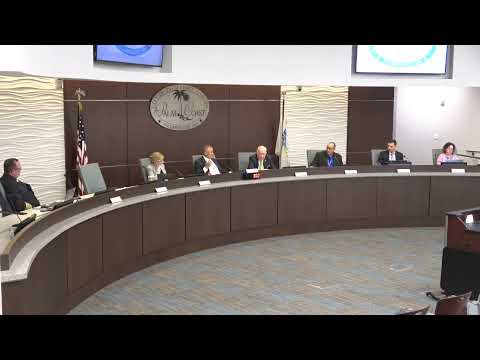
City planning staff presented a package of proposed amendments to Chapter 5 (transportation, connectivity and parking) of Palm Coast’s Land Development Code at the Oct. 28 workshop, emphasizing consistency with recent comprehensive-plan updates and alignment with state funding standards.
Fung Wing, planning manager, said the changes would add e-bikes and micromobility to the code, increase the threshold that requires two access points for a new residential subdivision from 50 to 100 dwelling units (and require two paved entrances at 250 units), widen recommended trail widths to 12 feet to strengthen eligibility for state grant programs, and clarify shoulder and sidewalk standards.
Staff also reported the city’s sidewalk in-lieu fee was revised recently to roughly $55 per linear foot (based on a 5-foot-wide, 4-inch-thick sidewalk assumption) and will be presented with accounting for how funds are spent. Wing said the city will provide a sidewalk-and-trails master plan and a fund accounting to show receipts and expenditures.
Parking and design questions
Council members raised practical questions about how to operationalize the changes. Vice Mayor Panieri asked how the code would ‘‘discourage’’ local streets from functioning as collectors; staff said collectors are defined to prohibit driveway connections and this design standard would be enforced in new development. Council members asked for explicit definitions of when pedestrian or bicycle links to trails are ‘‘unsafe’’ and who decides that exception; staff agreed to provide objective criteria.
Council also queried parking-table entries (for multi-tenant retail centers and storage facilities), periodic overflow-parking definitions, and the flexibility standard for administrative deviations (staff currently allows up to 20% over the requirement and requires a justification and comparison sites for reductions). Members asked staff to codify any standard deviation thresholds for predictability; staff agreed to return with explicit language.
Why it matters
The amendments are intended to make the city’s regulations consistent with current accepted engineering practice and state grant criteria, reduce ambiguity for developers and the public, and improve pedestrian/bicycle connectivity. Council signaled support for codifying fee indexing and clearer deviation standards so the rules are predictable for applicants.
Next steps
Staff will incorporate council edits, provide the sidewalk/trails master plan and fund accounting, and bring refined code language back through the Planning and Land Development Regulation Board and subsequent council readings. Some amendments may be delayed pending the legislature’s clarification of Senate Bill 180 provisions related to burdensome local requirements.