Get Full Government Meeting Transcripts, Videos, & Alerts Forever!
Get email alerts on the Mobile Food Trucks topic
No spam. Unsubscribe anytime.
Palm Coast council pushes to ease rules for food trucks after vendors warn ordinance is too burdensome
Summary
City staff showed a draft ordinance to allow food-truck parks and accessory food-truck operations; vendors and council pressed to loosen site-plan, fee and parking requirements, add local-operator preference and expand allowed zoning to Industrial 1 and COM1–3. Staff will revise the draft for Planning Board review.
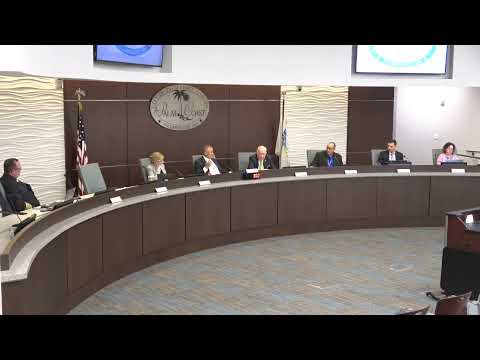
Palm Coast City Council members signaled support on Oct. 28 for loosening proposed rules that would govern where and how mobile food dispensing vehicles (food trucks) may operate, after owners and vendors said the draft ordinance would be too costly and restrictive for small businesses.
Michael Hansen, community development staff, presented a draft that would allow two types of MFDV operations: principal ‘‘food-truck parks’’ in COM2/COM3 zoning (minimum 20,000 square feet, up to 15 truck spaces, 30-by-20-foot pads and 10-foot fire separations) and ancillary/accessory operations on public parkland or on private parcels that meet site-plan standards. Hansen said the draft is intended to ensure compliance with Florida Statute 509.102, which preempts local governments from outright bans on food trucks, while adding safety, parking and sanitary requirements.
‘‘This ordinance is basically just builds upon that to allow for additional operation of food trucks within the city,’’ Hansen said, describing pad sizes, separation requirements and restroom/parking minimums linked to Florida building and fire codes.
Food-truck owners and vendors strongly urged changes. Steve Sherman, whose son operates a local truck, said outreach to operators was limited and criticized parts of the draft: "We were never contacted... I'm willing to offer my son's help," he told the council. Vendor Sheila Hines said a $2,000 site-plan requirement would be prohibitive for many operators and argued that state licensing already regulates food-safety and inspections. ‘‘We are small business,’’ Hines said. "We pay taxes here. We should be able to service the people that live here.”
Vendors and some council members asked for simpler, lower-cost options — such as allowing lined-off parking stalls at commercial sites (Home Depot, Lowe’s, Tractor Supply were discussed as examples), a reservation or rotation system for high-demand venues, and a local-operator preference for city businesses. Councilmember Panieri said he wanted clarification that accessory use in COM1/COM2/COM3 and Industrial 1 be allowed so that a property owner could designate a pad without creating an oversized new ‘‘food-park’’ development.
Hansen told council that site-plan approval applies to the parcel (not every visiting truck) and that a one-time development order would typically run with the property. He estimated up-front survey/title costs could put total modification costs at a"few thousand dollars" depending on the site, while special-event permits for city parks would continue under a different fee structure.
Council direction and next steps
Councilmembers asked staff to: expand accessory-use permission to Industrial 1 and to COM1/COM2/COM3, review a reservation/permit system (via CivicRec) for parks, consider local preference for Palm Coast-based operators, ensure permit fees remain cost-recovery (and reexamine whether a distinct, lower-fee path could be used for food-truck site modifications), and clarify exemptions for temporary commercial kitchens when a fixed restaurant is under renovation.
Hansen said he would rework the ordinance consistent with council feedback, expand stakeholder outreach (he acknowledged limited early contact with operators), and return the revised draft to the Planning and Land Development Regulation Board for review. Staff initially cited PLDRB on Nov. 19 and council first/second-readings in December/January, but multiple speakers noted the schedule could shift as staff revises the draft and gathers input.
Why it matters
Food-truck operations provide income for local small businesses and can fill lunch and event-service gaps where brick-and-mortar dining is limited, speakers said. At the same time, the city faces safety, parking and sanitation responsibilities that the ordinance seeks to address. Council members emphasized balancing small-business viability, resident safety and consistent regulation across public and private property.
What’s next
Staff will revise the draft to reflect council direction, perform broader outreach to local vendors, and return with updated language, fee estimates and an implementation plan for the permitting/reservation system. Affected vendors were asked to provide contact information to staff before leaving the meeting.