Get Full Government Meeting Transcripts, Videos, & Alerts Forever!
Get email alerts on the Zoning Rewrite topic
No spam. Unsubscribe anytime.
Tiverton Planning Board advances zoning rewrite at Oct. 30 workshop; schedules fall public hearings
Summary
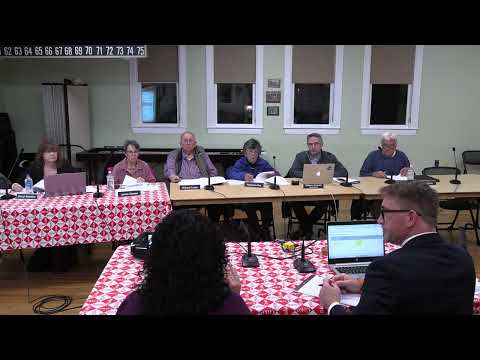
The Tiverton Planning Board met in a special workshop Oct. 30 to continue a multi‑month review of zoning and subdivision revisions required by recent changes in state law.
The Tiverton Planning Board met in a special workshop Oct. 30 to continue a multi‑month review of zoning and subdivision revisions required by recent changes in state law. The session, led by the board chair, was convened as a workshop rather than a formal meeting; board members heard a section‑by‑section briefing from planning staff and counsel and gave direction on several substantive points ahead of public hearings.
Consulting staff and counsel reviewed proposed definition and transition rules, district use changes for waterfront zones, adaptive‑reuse language for mills and factories, and a set of design‑standards moved into the subdivision regulations. Todd Romano, the board’s assistant solicitor and planning board counsel, and planning staff explained edits intended to bring the ordinance into conformity with state law while preserving local implementation authority.
On technical items, the board asked staff to review the shared‑parking language (currently limited to general commercial zones) and to tighten references to state environmental definitions for large composting facilities. Members discussed language added to encourage adaptive reuse of textile mills and similar commercial buildings; staff noted that the term 'mills' mirrors recent state phrasing and recommended keeping that alignment.
A major portion of the workshop focused on accessory dwelling units (ADUs). Staff reviewed state minimums and the town’s proposed approach to maximum sizes and accessory‑structure calculations. The board discussed whether detached ADUs built above garages should have the garage counted toward an ADU cap, and how local enforcement can track initial occupancy restrictions versus later rental use. Staff recommended clear definitions and a set of standard responses for recurring, novel proposals while noting enforcement options are constrained by state law.
Fence‑height rules also drew extended discussion. Planners proposed a residential front‑yard maximum of 4 feet (6 feet at side/rear), no front‑yard fences in form‑based waterfront/main‑street districts, and higher allowances in industrial/PDP districts. After debate about sight lines, historic stone walls and screening needs, the board moved toward an 8‑foot front / 10‑foot side‑and‑rear standard for industrial/PDP with the ability to provide relief where appropriate.
The board also reviewed design standards, a plan to reference the municipal fee schedule rather than embedding a fixed dollar amount for fence permits, and the creation of consolidated checklists for development plan review to avoid certification gaps. On vesting ('best of rights') staff tightened language to link vesting to a certificate of completion to reduce ambiguity.
No formal votes were taken; the workshop produced direction and redlines. The board asked staff to prepare a revised public‑hearing draft and recommended placing a zoning‑focused advisory discussion on the Nov. 6 agenda and advertising a public hearing on the subdivision/regulation package for early December. “This is grueling, detailed work. I thought it’s essential,” the chair said in closing, thanking staff for the effort.
Next procedural steps: staff will return with updated language on parking, shared‑parking allowances, the composting definition (linked to DEM), ADU clarifications, and consolidated DPR checklists for review prior to the November and December hearing dates.