Get Full Government Meeting Transcripts, Videos, & Alerts Forever!
Get email alerts on the Capital Improvements topic
No spam. Unsubscribe anytime.
Loveland City Council reviews $7.5 million proposed 2026 CIP, hears PFAS funding outlook
Summary
City staff presented a $7.5 million 2026 Capital Improvement Program emphasizing pedestrian projects, PFAS treatment design, expanded road work and cybersecurity; staff outlined grant funding, a $4 million EPA construction grant possibility and remaining funding needs estimated in the millions.
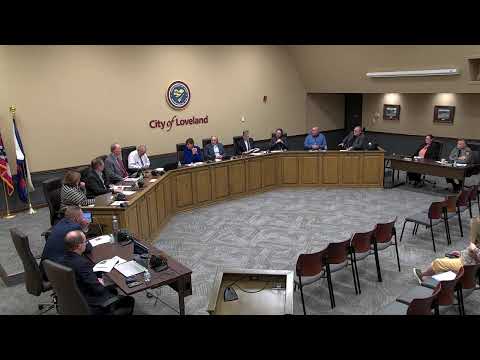
Loveland City Manager Dave Kennedy on the council dais presented the draft 2026 Capital Improvement Program on behalf of city staff, saying the plan centers on council goals and public input and lists roughly $7.5 million in proposed investments for 2026.
The presentation highlighted four “feature” projects: pedestrian improvements along Loveland‑Madera Road; PFAS water‑treatment design; Oakland Road sidewalks; and the annual road program. Kennedy credited Finance Director Mark and City Engineer Kelsey Richards for their roles in assembling the plan and said many projects are grant‑dependent.
Kennedy and public‑works staff described Loveland‑Madera Road Phase 1 as a utilities‑and‑sidewalks project from Castle Skateland to the city limits that will require utility relocations, retaining walls and a reinstated mid‑block crossing at the Kroger entrance. “As soon as we clear right of way, which will be at the end of this year, we will get the utilities moving,” Public Works staff member Chris said, noting Duke Energy pole moves must be coordinated with the city and ODOT.
On the city’s PFAS response, staff said design work is fully grant funded and will continue through 2026. Chris told the council the city received approximately $1.3 million in grant/loan‑forgiveness funding for full design of a 4 million gallon‑per‑day granular‑activated‑carbon treatment plant and related building and process changes, including converting from chlorine gas to liquid chlorine. “We will continue the design on that all through 2026, and that will lead into 2027,” he said.
When council members asked about construction funding, staff said the Ohio EPA WSRLA program can provide up to $4 million in construction grant money. The city also expects settlement proceeds from manufacturers; staff estimated “approximately $2,000,000” from earlier settlements (3M/DuPont) so far and said amounts from other settlements (BASF, Tyco) were not yet known. Based on prior studies — which included a roughly 30% contingency — the projected construction cost at the study stage was about $17 million. Chris summarized the near‑term funding picture: “I do believe there’s at least $6,000,000 that we will be able to get in grant money…we’re going to have approximately, right now, say $11,000,000 of monies that we will have to figure out how we’re going to fund.”
Staff described the annual road program as funded from six different funds. City Engineer Kelsey Richards cited a 2019 Stantec pavement analysis that recommended $880,000 per year; the city has averaged $982,821 annually on the road program since that report and has spent $5,999,750 on roads (through 2025). Richards said the Stantec study typically programs a 15‑year cycle for addressing the street network.
Council members asked detailed questions on contractor and utility coordination (particularly Duke Energy’s pole moves), and staff said active engagement in milestone and progress meetings is the primary mitigation strategy. Kennedy said phase 2 of Loveland‑Madera — the buried‑utilities phase — will require heavier coordination with utilities and businesses.
The presentation also covered smaller projects in the downtown TIF such as a low‑cost curb‑and‑sidewalk loop on North Carl Brown Way, a downtown business directory, park playground upgrades at Nisbet Park (including artificial turf for ADA accessibility), security fencing at the Union Cemetery water tower, and targeted cybersecurity investments. Chris said the city plans to spend roughly $95,000 in 2026 on cybersecurity work with a third‑party vendor (Velicore), including penetration testing every six months and endpoint hardening shared across city funds.
On public‑safety technology, council asked about a proposed drone program. The department chief said staffing would start small — two operators initially, potentially up to four — and the city would seek FAA licensing for operators and one multi‑sensor drone (day camera plus FLIR) expected to cost roughly $30,000–$40,000. The chief said video storage and records‑release handling would be part of vendor negotiations and policy review.
Council members praised staff work and the long‑range approach. The meeting closed with a motion to adjourn that carried on a 7–0 roll call vote.
Next steps: staff will continue design work on PFAS and the CIP priorities, pursue grant opportunities (including WSRLA and Safe Routes to School), advance right‑of‑way and utility coordination for Loveland‑Madera phases, and return to council as funding and project milestones develop.