Get Full Government Meeting Transcripts, Videos, & Alerts Forever!
Researcher: 19th-century settlers often turned ancient mounds into cemeteries, study finds
Summary
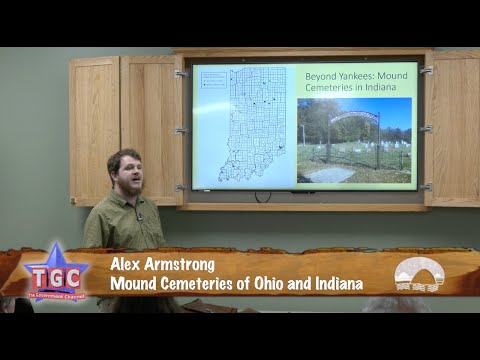
At a public talk in The Plains, Alex Armstrong summarized his master's thesis showing that New England–origin settlers disproportionately established 'mound cemeteries' in Ohio; he tied the practice to classical tastes, memorial trends and local copying, and discussed stewardship and recent repatriation examples.
Alex Armstrong, board president of Friends of the Plains Mounds and a recent Ohio University master's graduate, told a Plains audience that his thesis finds 19th-century settlers frequently reused ancient Native American earthworks as cemetery sites.
Armstrong said the pattern is not random. "Almost half of the mound cemeteries were established by Yankees when they made up less than a quarter of the settlers," he said, noting that his maps for Ohio and Indiana show an uneven geographic distribution. He cited Mills' Archaeological Atlas counts to illustrate contrasts: "of the 419 mounds that Mills discovered in Ross County, only 1 was turned into a cemetery," while some other counties have a much higher conversion rate.
Why the pattern? Armstrong linked the practice to cultural fashion and memorial priorities among migrants from New England and upstate New…
Already have an account? Log in
Subscribe to keep reading
Unlock the rest of this article — and every article on Citizen Portal.
- Unlimited articles
- AI-powered breakdowns of topics, speakers, decisions, and budgets
- Instant alerts when your location has a new meeting
- Follow topics and more locations
- 1,000 AI Insights / month, plus AI Chat