Get Full Government Meeting Transcripts, Videos, & Alerts Forever!
Get email alerts on the Mound Cemeteries Research topic
No spam. Unsubscribe anytime.
Researcher: 19th-century settlers often turned ancient mounds into cemeteries, study finds
Summary
At a public talk in The Plains, Alex Armstrong summarized his master's thesis showing that New England–origin settlers disproportionately established 'mound cemeteries' in Ohio; he tied the practice to classical tastes, memorial trends and local copying, and discussed stewardship and recent repatriation examples.
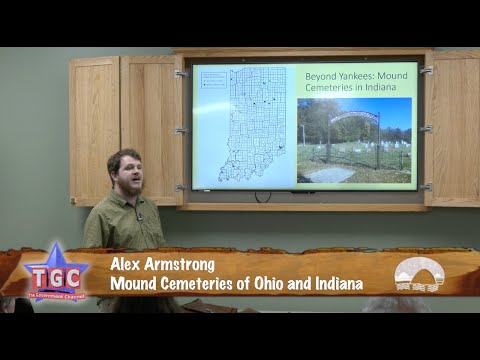
Alex Armstrong, board president of Friends of the Plains Mounds and a recent Ohio University master's graduate, told a Plains audience that his thesis finds 19th-century settlers frequently reused ancient Native American earthworks as cemetery sites.
Armstrong said the pattern is not random. "Almost half of the mound cemeteries were established by Yankees when they made up less than a quarter of the settlers," he said, noting that his maps for Ohio and Indiana show an uneven geographic distribution. He cited Mills' Archaeological Atlas counts to illustrate contrasts: "of the 419 mounds that Mills discovered in Ross County, only 1 was turned into a cemetery," while some other counties have a much higher conversion rate.
Why the pattern? Armstrong linked the practice to cultural fashion and memorial priorities among migrants from New England and upstate New York. Citing cultural geographer Wilbur Zelinsky and examples from popular 19th-century literature, he said Yankees embraced classical references—town names and personal names drawn from Greece and Rome—and that association made mounds appealing symbolic places to bury the dead. "You see this tombstone in Rome Township in Athens County: there’s a guy named Seneca," he said as an example of classical naming.
Armstrong also placed mound cemeteries in the context of the mid-19th-century rural cemetery movement, when landscaped, picturesque burial grounds became desirable. He described mechanisms that spread the practice—family ties, travel and transport routes, and circulation of ideas through tourism—pointing to Marietta's nationally known Mound Cemetery as a likely model copied by other communities.
He stressed that the phenomenon is historically complex. Armstrong said not every elevated feature labeled a "mound" is an archaeological mound and that local perceptions matter: "If people think they are interacting with an ancient site, then it's the same cultural phenomenon as far as I'm concerned." He described examples where graves encountered older remains and reported reinterment of bones and relics in a way contemporaries described as respectful.
The presentation also addressed contemporary stewardship. Armstrong told the audience that recent developments, including the UNESCO World Heritage designation for Ohio's Hopewell Earthworks, have increased public attention to earthworks. He described a repatriation example in Upper Sandusky: "the United Methodist Church contacted the Wyandotte nation out in Oklahoma and said, you know, would you like us to grant you this property back?" Armstrong said the Wyandotte Nation accepted and has invested in restoring the church and cemetery site.
Audience questions covered excavations and finds (shells of artifacts, occasional human remains and grave goods), geomorphological debates over glacial kames versus mounds, and whether mound burials represent social elites. Armstrong responded that archaeological evidence varies; some mounds contain many burials and grave goods, others only a few, and both cremation and inhumation occur.
Armstrong closed by urging better local interpretation: most mound cemeteries lack signage explaining their archaeological or Indigenous histories. He encouraged more documentation and suggested overlaying cemetery location data with mound records as a possible next research step.
The talk concluded with a short Q&A and offers to share the maps and archival resources Armstrong used in his research.