Get email alerts on the Unified Development Code topic
No spam. Unsubscribe anytime.
Edmond officials unveil draft Unified Development Code, propose context-based zoning and staged site-plan reviews
Summary
City staff and consultant Fries & Nichols presented a draft Unified Development Code that consolidates Titles 21–23, reduces defined uses from 128 to 80, creates three context areas plus corridor overlays, and proposes four site-plan types to stage submissions; outreach and adoption are planned for spring 2026.
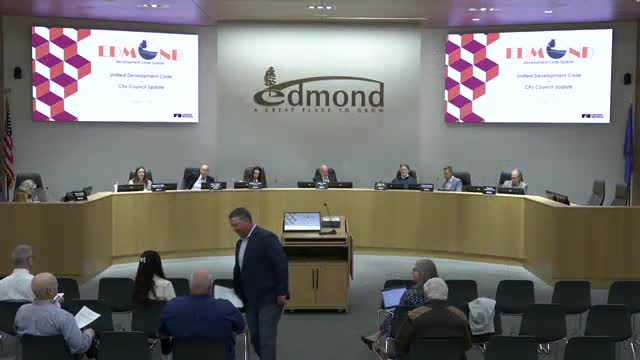
Edmond — City staff and consultants presented a draft Unified Development Code on Oct. 27 that would reorganize the municipal development rules into a single, context-based document and change how many land-use decisions are reviewed.
Becca Patrick, the city’s project manager and senior planner, told the council the work began in June 2022 and is “about 60% of the way through” the drafting process. Dawn Thomas, project manager for Fries & Nichols, said the draft aims to streamline reviews, clarify responsibilities, and align regulations to the goals in the Edmond plan.
The draft would consolidate multiple titles of the Edmond Municipal Code — including subdivisions, zoning and stormwater rules — into five chapters and reorganize zoning by context areas: rural, suburban and urban, with corridor overlays for major routes such as Route 66 and I-35. Thomas said the proposed map reduces the number of zoning districts from the current inventory and narrows the menu to roughly 10 primary districts while maintaining planned-unit developments as a special designation.
A key technical change in the draft is the simplification of the permitted-use table. Thomas said the team reduced the number of uniquely defined uses from 128 to about 80 by grouping similar retail and food-service uses into broader categories (for example, combining separate listings for bakeries and ice-cream shops under a single “small restaurant/café” use). The draft also expands the number of uses that are permitted by right in multiple districts and creates a “limited use” category, which would be permitted subject to use-specific standards.
The code would also introduce four site-plan types (0–3) tied to project scale and review level. Type 0 covers building-permit-level reviews such as single-family homes; higher-numbered types require progressively more documentation and higher-level review. Thomas said the intent is to let applicants stage detailed, costly engineering plans until staff has determined the basic eligibility of a project.
On procedural changes, Thomas described “minor modifications” as narrowly defined administrative relief — for items such as setbacks, building height or landscape area — that staff could approve when specific criteria are met; appeals and requests that fall outside those parameters would move to the Planning Commission or Board of Adjustment.
Council and Planning Commission members pressed for clarity on several points. Councilman Moore called the effort “a massive undertaking” and urged attention to unintended consequences, noting the council and public will need clear flowcharts and examples to compare current rules with the proposed changes. One commissioner asked how the new process would provide developers enough certainty before they invest in detailed plans; Thomas said staff will work to provide conditional assurance when applicants meet objective criteria.
Councilmembers also questioned how citizen participation would be preserved if more actions become administrative approvals. Thomas replied that any item taken to the Planning Commission would include a public hearing, while strictly permitted uses that meet clear, objective criteria would not require additional citizen hearings. The team plans multiple outreach events: Thomas said consultants anticipate up to four open-house meetings and additional workshops before formal adoption.
Food trucks and mobile vendors drew specific attention. A councilmember said he has observed vendors parked in one location for months and asked whether those should be treated differently; Thomas said mobile vendors on private property should be treated as a permitted use, while vendors on public property could be regulated as temporary uses with mitigation requirements.
The consultant outlined next steps: internal testing of the draft, publication of user-friendly materials and graphics, creation of equivalency tables showing how current districts map to the new categories, and public notice to property owners ahead of adoption. Thomas said the team is aiming to begin the adoption process in spring 2026 but cautioned the schedule could shift depending on outreach needs.
The meeting closed without any code votes; the council adjourned after a procedural motion passed 5–0.
Sources: Presentation and Q&A at the Oct. 27, 2025 Edmond special meeting; quotes and technical details from Becca Patrick, project manager and senior planner (City of Edmond), and Dawn Thomas, project manager (Fries & Nichols).
AI generated
The text on this page is AI generated. Summaries, highlights, analysis, and video transcripts are all produced from the original source material.
AI can make mistakes, so if you spot one, and we will fix it for everyone.
Note: the source content is unaltered by us. Any content source we link to, be it a video, an audio recording, or a document, is presented exactly as its publisher released it. That publisher is usually a government body, sometimes an individual official or another organisation.