Planning Commission backs text amendment to ease child care permitting
Loading...
Summary
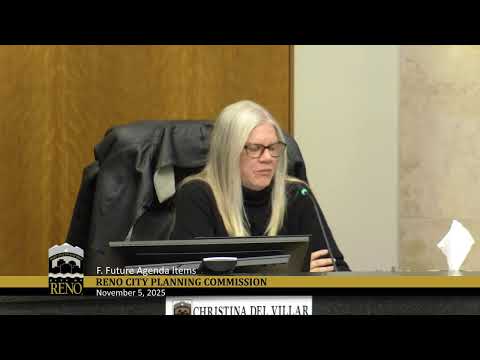
The City of Reno Planning Commission voted unanimously Nov. 5 to recommend that the City Council approve a zoning text amendment intended to remove planning barriers for child care providers.
The City of Reno Planning Commission voted unanimously Nov. 5 to recommend that the City Council approve a text amendment aimed at easing local planning barriers for child care providers. The amendment (case TXT226-00001) would eliminate the minor conditional use permit (MUP) requirement for in‑home and workplace child care and reduce the conditional use permit (CUP) requirement to an MUP for child care centers in residential zones, while incorporating several mitigation standards into code.
Senior Management Analyst Grace MacKinnon told commissioners the measure responds to a statewide shortage — “72% of Nevadans live in a childcare desert” and the region saw a 55% decline in child care from 2018 to 2024 — and was initiated by council to remove local barriers where possible. MacKinnon said the city’s scope is limited by state licensing and public‑health rules, so staff focused on land‑use hurdles they can control: the application timeline, fees and uncertainty tied to MUPs and CUPs.
Under the proposed code changes, staff would codify commonly required conditions to mitigate impacts rather than require separate discretionary reviews. The standards added to code include a pickup and drop‑off plan, shielded outdoor lighting when adjacent to residential uses, a six‑foot fence where the child care use abuts residential property, and restrictions on outdoor play hours next to residences. MacKinnon said providers can request flexibility through a minor conditional use permit if they cannot meet standards exactly.
Commissioners asked for clarifications. Commissioner Vallejo asked why some proposed language refers to “residential use” rather than “residential property”; staff said the phrasing aligns with existing zoning language and is intended to capture actual residential activity rather than only parcels zoned residential. Commissioner Becerra asked whether staff recommends codifying a solid fence or leaving screening to administrative discretion; staff said both approaches are acceptable and left the choice to the commission’s recommendation.
No members of the public registered to speak on the item. During deliberations commissioners praised the effort to remove barriers while balancing neighbor concerns over noise and privacy. Commissioner Becerra moved to recommend approval “based upon compliance with the applicable findings,” and the motion carried unanimously.
The commission’s recommendation moves TXT226-00001 to the City Council for first reading; staff indicated council first reading is expected in December with potential adoption in early 2026.
Authorities and documents referenced in the hearing include the staff report for case TXT226-00001 and related municipal zoning code provisions (noted in the staff report).