
WSBA clarifies rules after board restores sections’ ability to use section funds for alcoholic hospitality
Get AI-powered insights, summaries, and transcripts
Subscribe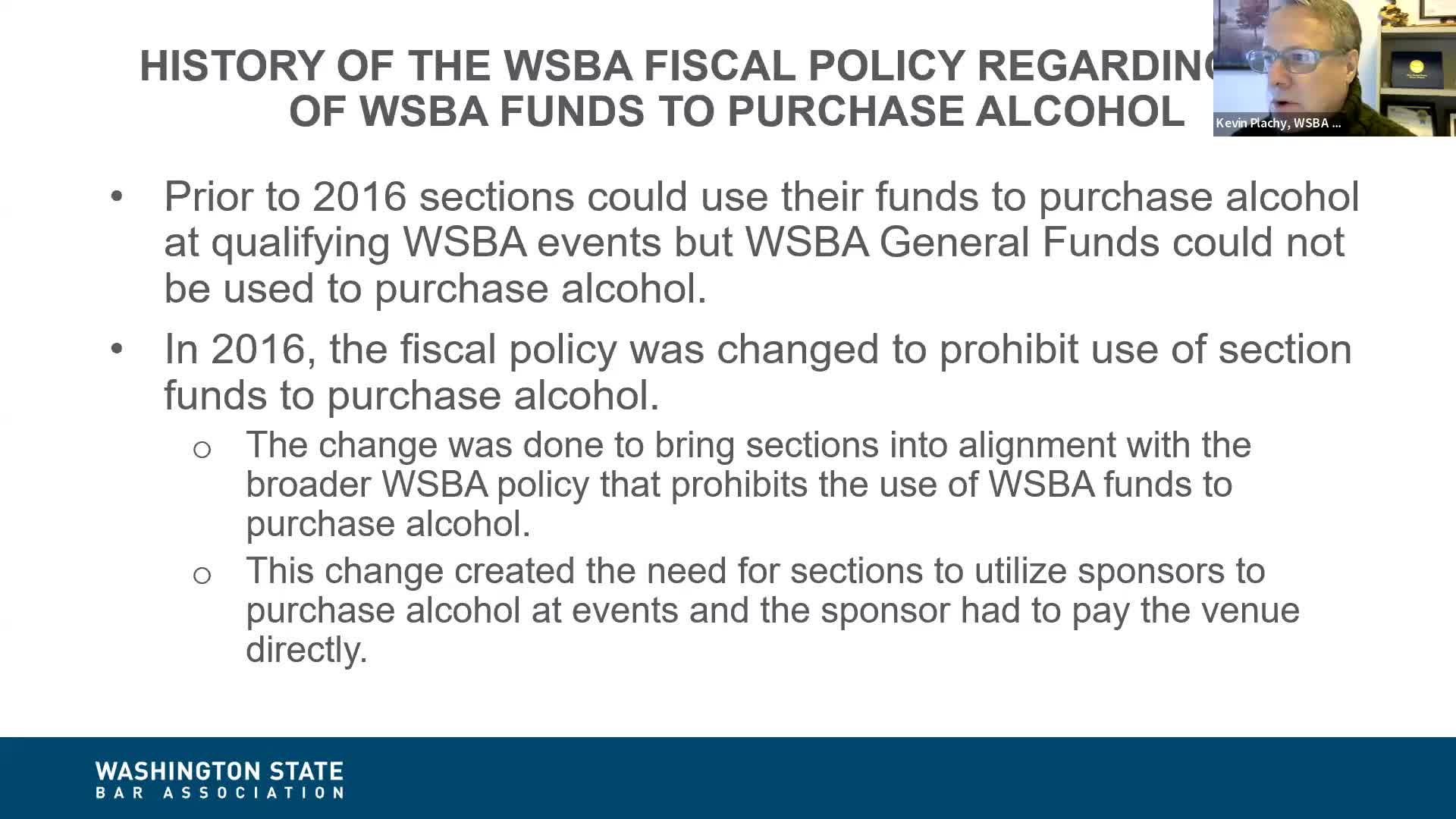
Summary
The Washington State Bar Association’s July board vote allows sections to use section funds to pay for alcohol at qualifying WSBA section functions, provided safeguards are met: licensed bartenders, minimum liquor-liability insurance, a two-drink host limit, nonalcoholic options, and executive director exception authority.
The Washington State Bar Association announced that sections may now use section funds to purchase alcohol at qualifying WSBA section events, reversing a 2016 restriction and restoring a practice members asked to resume.
Kevin Placci, WSBA advancement department director, told section leaders the board of governors voted in July to permit the change and that it applies only to ‘‘qualifying section functions’’—events or meetings hosted for the benefit of section members and open to all section members. He added that celebrations honoring many volunteers or speakers also qualify if invitations are extended to at least eight honorees.
Why it matters: The policy change affects event logistics and budget choices across the bar’s 29 sections and simplifies prior workarounds in which sponsors had to pay venues directly. Placci said sections may still solicit sponsors but now may accept sponsor funds to the section and pay the vendor from section accounts.
Safeguards and limits: Placci said WSBA requires alcohol to be served by a licensed, insured bartender and that venues or vendors carry minimum liquor-liability insurance of $1,000,000 per occurrence and $2,000,000 aggregate. ‘‘Drinks must be served by a licensed and insured bartender,’’ he said, and the policy limits hosted alcoholic drinks to two per attendee; ‘‘we would give 2 drink tickets per attendee,’’ he said. Nonalcoholic beverages must be available at any event where alcohol is provided.
Exceptions: The executive director may grant exceptions in particular circumstances, Placci said, for example if a vendor’s standard insurance limit differs but the vendor has a strong safety record.
What counts as a qualifying event: The association’s guidance distinguishes standard open meetings (for example, executive committee meetings) from qualifying functions and identifies typical qualifying uses such as receptions attached to CLEs, networking events open to members, and volunteer recognition events that meet the invited-honoree threshold.
Next steps: Staff advised sections to consult Carolyn McGregor or the sections team early in event planning to verify whether a proposed event qualifies and to ensure contract and insurance arrangements meet the policy’s requirements. Placci invited questions and offered his email in chat for follow-up.
The guidance came as part of a broader program of updates for section leaders covering project planning, bylaw cleanups and fiscal procedures.