
Baldwin-Whitehall audit: clean opinion, but officials warn state budget impasse risks cash flow
Get AI-powered insights, summaries, and transcripts
Sign Up Free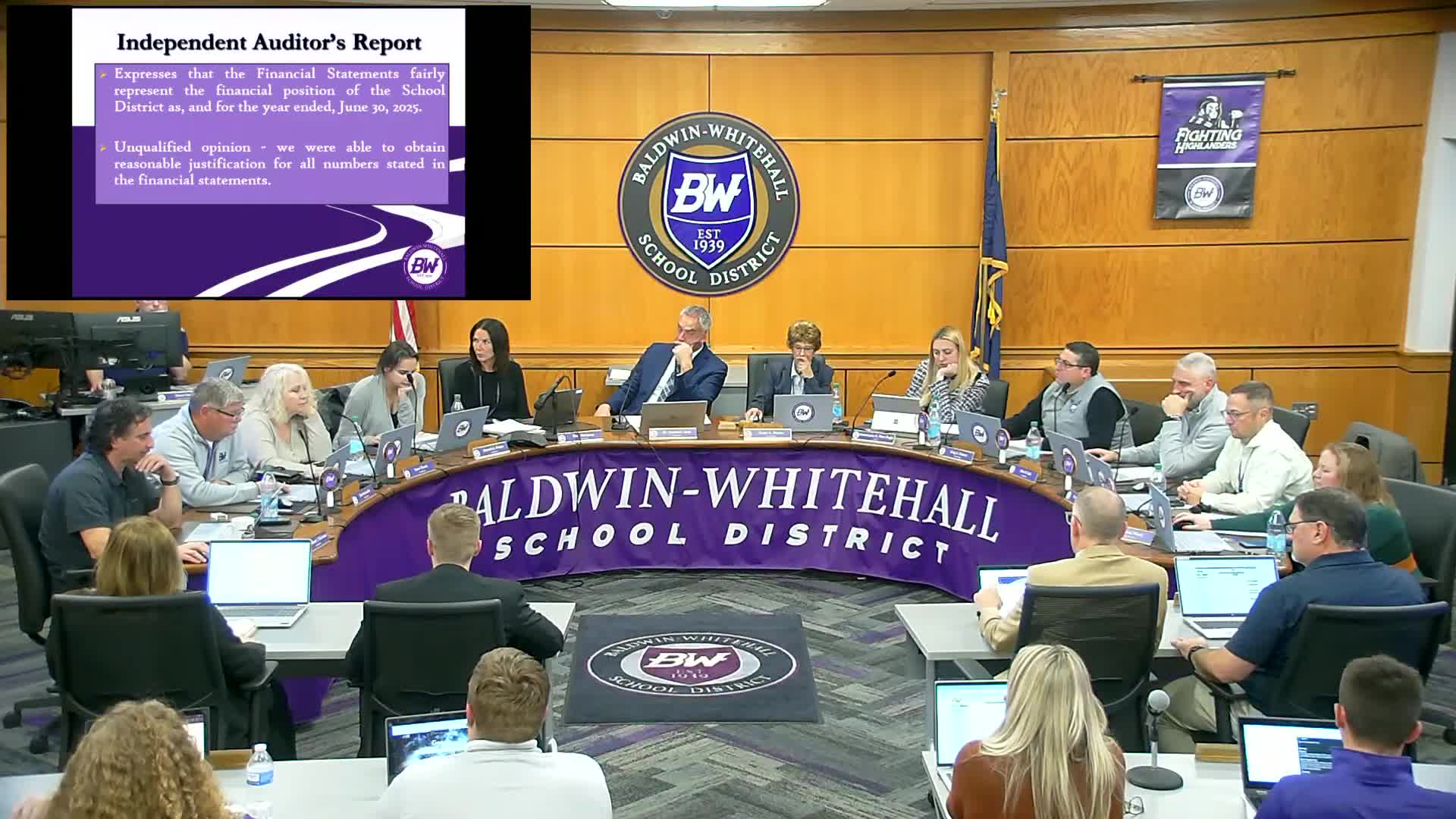
Summary
Auditors gave Baldwin-Whitehall an unqualified (clean) opinion for 2024–25 and the district reported a near-$31 million fund balance, but administrators warned a prolonged state budget impasse could force borrowing or program cuts and strain cash flow by February without state payments.
Auditors delivered a draft financial report to the Baldwin-Whitehall School District board on Tuesday, issuing an unqualified — or "clean" — audit opinion for 2024–25 while highlighting the difference between fund balance and available cash.
"We issued a clean opinion or an unqualified opinion for 20 four-twenty 5, which is the highest level of audit opinion that you can receive," auditor Grant Martin said during the presentation. The slides shown to the board reported a fund-balance total nearing $31,000,000 and roughly $3.3 million in net income for the year.
The audit team walked trustees through revenue and expenditure drivers: federal funding declined from COVID-era levels, the district carries roughly $86,000,000 in outstanding bonds, and major variances came from contracted transportation services and tuition payments for students placed outside the district. Auditors cautioned that fund balance is an accounting measure and may not reflect immediate cash on hand.
Meanwhile, district finance staff warned trustees the state budget stalemate creates an urgent cash-flow risk. "If there's no state budget passed, we will run out of money at the February," a finance official told the board, noting payroll costs are about $2.5 million per payroll (two payrolls monthly, approximately $5 million per month). Board members were also told some districts are borrowing or delaying state remittances to remain operational.
The district's business and finance staff said a range of contingency options exist — borrowing to cover shortfalls, cutting programs or staff where necessary, or temporarily suspending operations in extreme cases — and emphasized that borrowing carries unreimbursed interest costs. The auditors recommended the board consider cash-flow timing when evaluating capital projects and financing choices.
Board members praised the audit presentation. "It's better than last year — A plus," one trustee said after the review. The audit remains in draft form pending minor proofing changes, the auditors said, with no anticipated material changes to the opinion.
Next steps: the board received the draft audit and slides for review; staff and auditors said they will finalize the report after addressing proofing items. Trustees discussed monitoring cash flow closely while awaiting state and federal disbursements.