
Buxton residents warn of ‘disaster zone’ as Dare County lays out debris‑removal policy and seeks long‑term fixes for Highway 12
Get AI-powered insights, summaries, and transcripts
Sign Up Free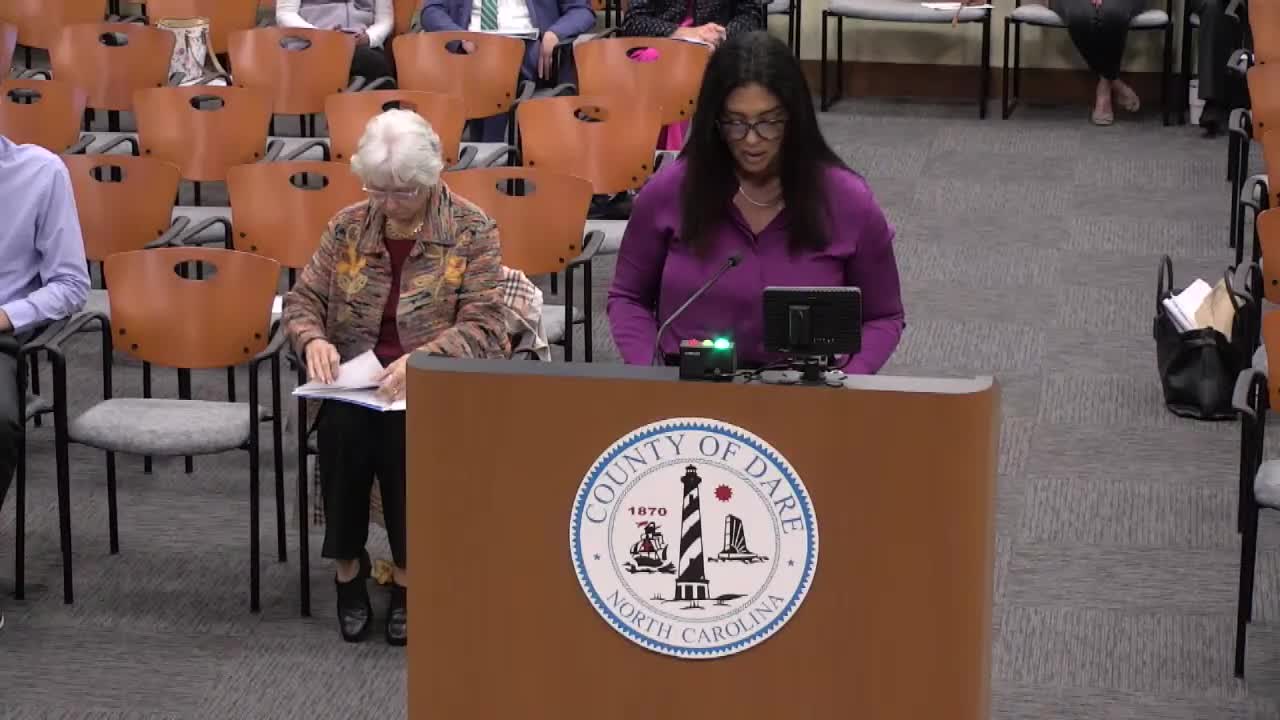
Summary
Buxton residents told the Dare County Board of Commissioners on Nov. 3 that repeated erosion and house collapses have created a "disaster zone," while the county clarified debris‑removal rules and outlined large‑scale nourishment projects.
Buxton residents told the Dare County Board of Commissioners on Nov. 3 that repeated erosion between Pea Island and Buxton has become a “disaster zone,” with dozens of houses lost and widespread yard debris stretching across neighborhoods.
"Highway 12 is our lifeline," said Christina Drum Boyd, a Hatteras Island property owner, urging the board to treat the road as critically important infrastructure and to push for permanent shoreline stabilizing measures. Boyd cited the county's 2013 shoreline management feasibility study and argued that semipermeable groins paired with monitored beach nourishment would be a more durable alternative to repeated emergency sand pushing.
Multiple Buxton residents described recent collapses that left refrigerators, building materials and household debris scattered onto private yards and roads. "It is a circus without a ringleader," said Betsy Gwen, who urged the county to designate an on‑site coordinator so cleanup contractors and homeowners know who is in charge.
County Manager Bobby Outten told the board that the county follows an incremental debris‑removal policy: when a single house falls, the property owner is responsible for cleanup; when multiple dwellings collapse or debris is commingled, the county will place dumpsters or direct owners to move debris to the public right of way for contractor pickup. Outten set a county deadline of Nov. 17 for property owners to put debris at the right of way; after that date the county will have contractors haul it away.
"If your house burns down, if your house falls in... it's your property," Outten said in explaining limits on county responsibilities. He added that when multiple houses fall and debris is commingled, the county will coordinate dumpsters or contractor removal from the right of way and has provided no‑tipping‑fee pickup for material collected there.
Speakers from Buxton pressed for faster and different action: local commenters said they had been asking for a state or local emergency declaration and for permanent shoreline solutions but found state agencies' response constrained by permitting and timing constraints. County and state representatives said a $45 million beach‑nourishment project is planned (timing dependent on seasonal windows) and a further $50 million package for additional nourishment or protective measures may be required to stabilize multiple areas. County staff said federal or state easement and permitting limitations affect where hardened structures can be sited and that some locations lie within national seashore or refuge lands where the county lacks authority.
Commissioners and staff also reported that they are pursuing a range of options — from targeted beach nourishment and potential short bridges to interagency petitions involving NCDOT, NCDEQ, DCM and the Army Corps of Engineers — while continuing to press state and federal officials for funding and expedited permitting. The board has formed or participated in a regional coastal counties coalition to amplify those legislative and permitting requests.
The board did not adopt a new local emergency declaration at the meeting. Next steps described to residents were: (1) follow the Nov. 17 debris staging instructions; (2) county staff will continue to coordinate with NCDOT, Park Service and state officials on structural and nourishment options; and (3) the board will pursue coalition and legislative pressure to secure additional funding and regulatory flexibility. Residents said they will continue to press for a named, boots‑on‑the‑ground coordinator for cleanup operations.