
Reno County Community Corrections outlines FY needs, seeks state funding increases
Get AI-powered insights, summaries, and transcripts
Sign Up Free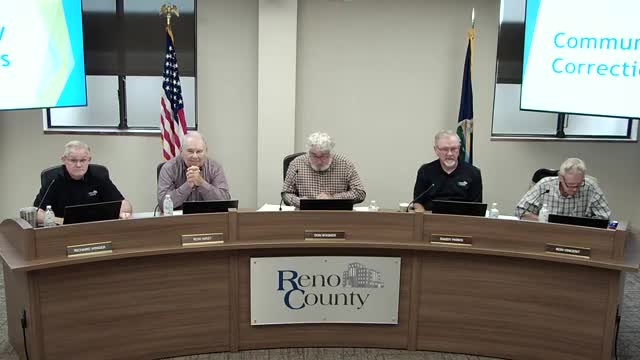
Summary
The county’s Community Corrections director reported on program goals, caseload composition and funding, and urged support for FY27 budget increases including $720,000 for adult supervision and $1.5 million for adult behavioral health services at the state level.
Randy Regier, director of Reno County Community Corrections, briefed commissioners on the department’s annual report, the population it supervises and funding pressures heading into FY27.
"Community corrections seeks to reduce recidivism and enhance public safety by providing evidence-based supervision and interventions," Regier said, summarizing the department’s mission. He described funding sources, noting that the two main grants from the Kansas Department of Corrections (adult and juvenile grants) fund supervision, while separate grants fund behavioral health and juvenile reinvestment services.
Regier outlined caseload composition for FY25, saying roughly two-thirds of the supervised adult population fall into drug-related categories, including cases eligible for Senate Bill 123 diversion treatment. He described program outcomes and termination categories used by the Department of Corrections, and provided operational data: drug-court participation, specialty groups focused on cognitive behavioral interventions, and juvenile supervision (21 youth served last fiscal year).
Looking ahead to FY27, Regier said community corrections is advocating for a $720,000 increase for adult supervision grants and a $1,500,000 enhancement for adult behavioral health funding to preserve service capacity and address inflation-driven cost increases. "We're asking for an increase in that," he said of the behavioral health grant, noting the program's buying power has declined since FY14.
Regier also described local program metrics including SB123 diversion enrollments and outcomes, and emphasized that the bulk of funds support personnel rather than equipment. Commissioners had no substantive follow-up questions during the presentation and thanked Regier for the report.
Next steps: Commissioners and staff may relay the department’s budget requests to state legislative contacts and continue to monitor grant opportunities and wage/retention pressures for corrections staff.