Get Full Government Meeting Transcripts, Videos, & Alerts Forever!
Get email alerts on the Zoning topic
No spam. Unsubscribe anytime.
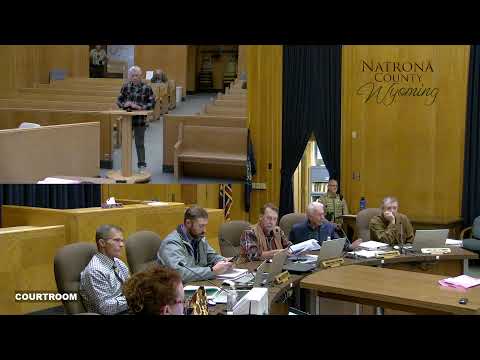
Commissioners weigh zoning resolution changes, ask staff to tighten industrial‑siting language
Summary
Planning staff previewed a wide-ranging set of clarifying amendments to the 2022 zoning resolution including wireless communications, signage and extractive industry buffers; commissioners asked for clearer, objective criteria for discretionary decisions and for the Industrial Siting Division language to be refined and returned Oct. 21.
Natrona County planning staff presented proposed amendments to the county’s 2022 zoning resolution, describing a variety of clarifying edits to correct contradictions and improve administration. The packet, described by the planner as a targeted set of clarifications rather than an overhaul, includes reorganized wireless communications facility rules, updates to PUD and sign language, a new commercial storage category, and an explicit reference to industrial/ heavy manufacturing that mentions nuclear manufacturing and compliance with state and federal law.
Commissioners immediately focused on large‑scale industrial siting language and process questions. Staff suggested pre‑application meetings and coordination with the Industrial Siting Division (ISD) and the 19 state agencies ISD invokes for projects of 50 acres or more so that county departments (road and bridge, weed & pest, parks, game & fish, DEQ) can be involved early. Several commissioners expressed concern that including ISD references without clear procedural rules could expose the county to legal uncertainty or inadvertently duplicate or conflict with state requirements. Others said early engagement with state agencies provides valuable technical expertise the county lacks.
A key point of debate was whether large industrial projects should be required to obtain ISD or ISC permits before the county holds public hearings. Staff advised against mandatory sequencing but said the new language would encourage early coordination and that the department could issue a more specific procedural flow chart. Commissioners asked staff to produce a more concrete application checklist (notice of intent vs. application; who to notify and when), add objective decision criteria (traffic, environment, watershed, neighborhood impacts) for discretionary waivers or buffers, and to propose clearer wording on extractive‑industry buffer minimums rather than leaving a purely discretionary ‘may require’ clause.
On the narrower but politically sensitive point of allowing “nuclear manufacturing” to be listed with heavy industrial uses, commissioners asked whether planners had consulted potential firms (e.g., Radiant) and requested more legal vetting of what the change would permit. Staff said the change is intended to make the ordinance explicit about industrial uses the county may need to accommodate, not to pre‑approve sites, and agreed to deliver revisions and sample application language at the Oct. 21 meeting.
No formal amendments were adopted; staff will return with redrafted language that lists process steps, required applicant materials and clearer objective criteria for discretionary decisions. The planning presentation and the discussion will be included in the packet for the October meeting.