Get Full Government Meeting Transcripts, Videos, & Alerts Forever!
Get email alerts on the Private Security topic
No spam. Unsubscribe anytime.
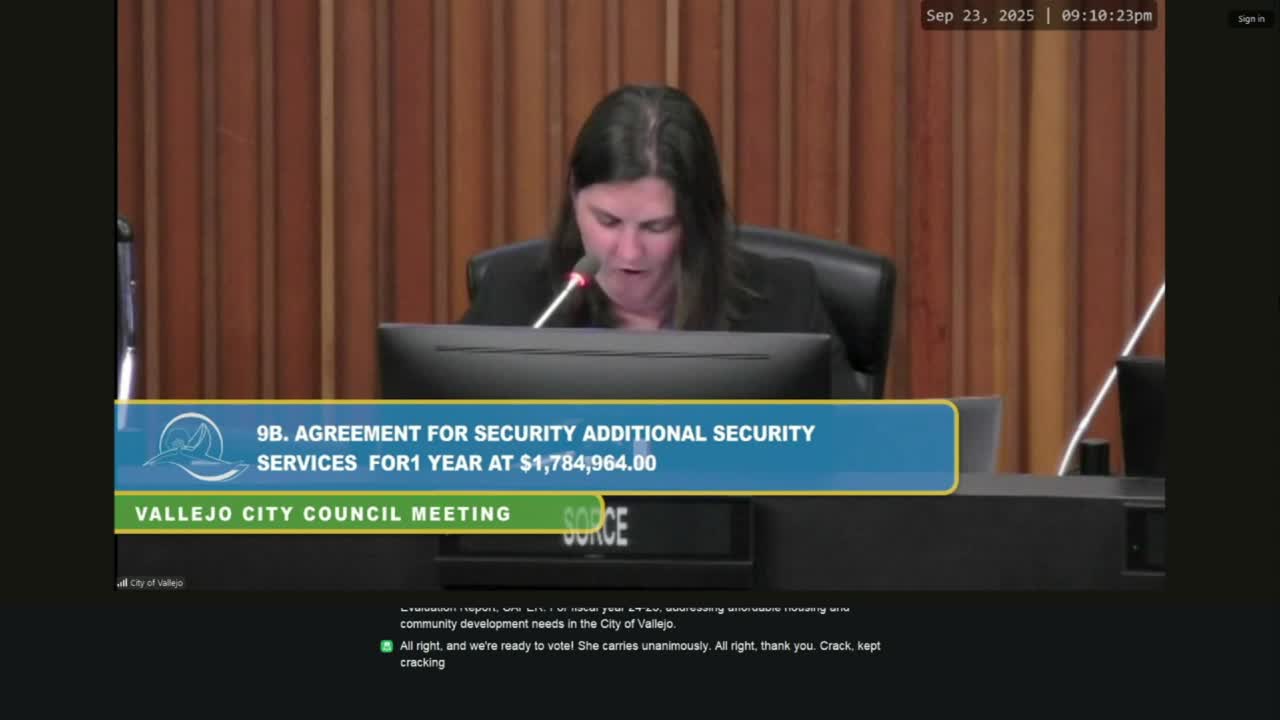
Vallejo delays final vote on expanded private-security contract; council demands metrics and breakdown
Summary
Council received a detailed briefing on a proposed citywide security contract with AX9 Security Inc., including a new neighborhood patrol pilot. Members pressed staff and the contractor for a clearer budget breakdown, performance metrics and reporting; council asked staff to return with more detail before final approval.
City staff presented a proposal to replace and consolidate existing city security services into a single agreement with AX9 Security Inc., a one-year contract with up to four one-year extension options and a year-one not-to-exceed total of $1,784,964. The package would roll baseline services (city hall interior/exterior, downtown parking lots, library and other ongoing posts) into the new contract and add a neighborhood pilot intended to provide supplemental patrols in crime "hot spots."
Interim Public Works Director Oscar Alcantar said the pilot would begin with one AX9 patrol vehicle operating about 40 hours per week at an initial cost of roughly $72,800 annually for the added patrol; staff and the contractor described an enhanced pilot allocation as roughly $500,000 drawn from Measure P funds to cover expanded coverage and additional baseline services beyond what the city currently pays.
AX9 representatives described daily GPS- and photo-stamped check-ins, vehicle-mounted cameras, and monthly reporting to the city. "We will then report that information back to the city ... and we'll have our monthly and quarterly meetings with the city to go over how effective it is," AX9's operations manager said. The contractor confirmed guards would not be armed or replace law enforcement; they would call VPD for incidents requiring police response.
Council members pressed for written performance metrics (crime reduction in specified beats compared with historical averages, response/incident reporting rates, and a clear definition of the patrol routes and hot-spot methodology). Several council members also asked for a line-item budget showing baseline services the city already pays for versus the new or enhanced services the city is being asked to fund. Concerns included the pilot's long-term cost, whether guards wear body cameras (vendor said vehicle-camera systems are provided; guards do not wear body-worn cameras initially), and the frequency of council reporting.
City staff and the contractor agreed to return with a clearer cost breakdown, the routes/hot-spot lists that AX9 will use, and an agreed set of metrics to evaluate the pilot. The council did not approve the contract that night and directed staff to bring the item back with the requested information and the meet-and-confer side letter with the police association finalized.
Next steps: staff will provide a full budget line-itemization of baseline versus enhanced services, a hot-spot route list developed with VPD, and a monthly reporting plan for the pilot year so the council can evaluate cost-effectiveness and potential renewal.