Get Full Government Meeting Transcripts, Videos, & Alerts Forever!
Get email alerts on the Clipper Revenue Loss topic
No spam. Unsubscribe anytime.
SolTrans asks staff to press MTC after analysis finds about $719,000 in Clipper revenue shortfalls
Summary
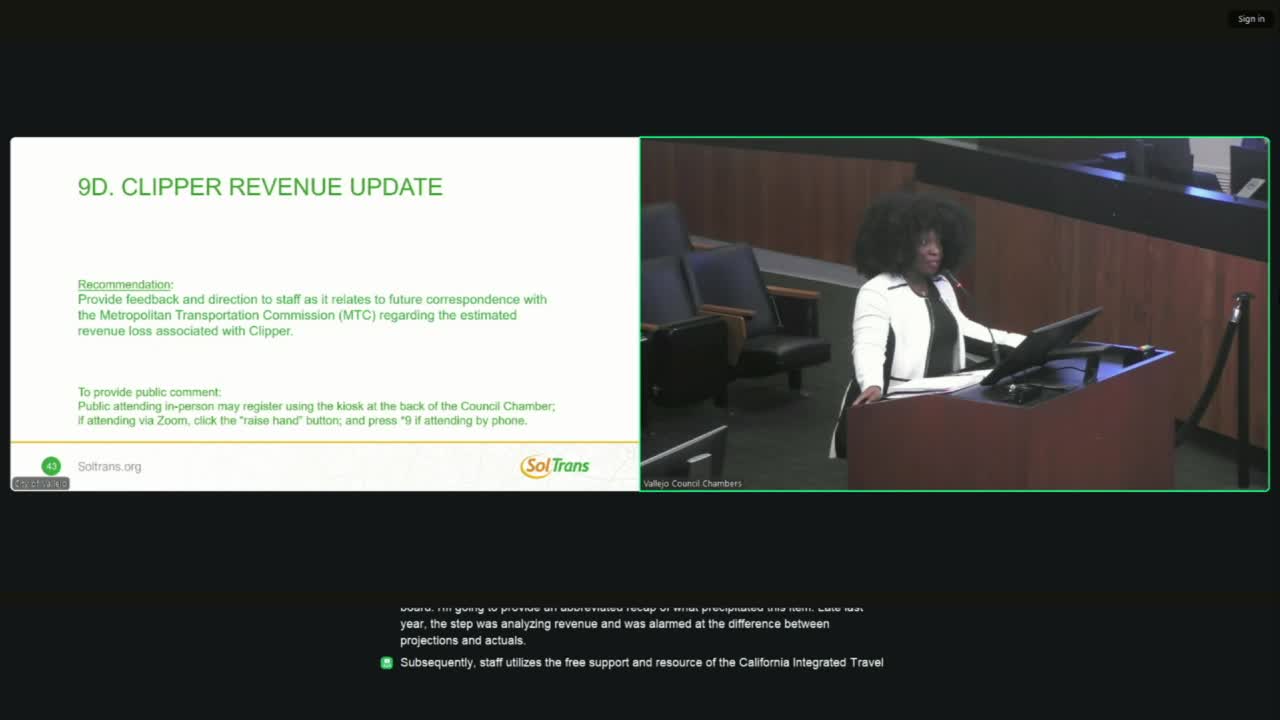
Staff told the board an analysis identified roughly $719,000 in estimated Clipper‑related revenue loss from April 2023–June 2025; the board directed staff to draft a strongly worded letter to the MTC asking for remediation or compensation and asked the MTC commissioner on the board to champion the request.
SolTrans staff reported to the board that a California Integrated Travel Project (CAL ITP) analysis of regional Clipper data identified triggers that, taken together, produced an estimated revenue shortfall of about $719,000 across the agency’s fleet from April 2023 through June 2025.
Staff emphasized the estimate is dependent on continued monitoring and that some root causes lie outside SolTrans control, including regional ticketing and performance issues. The board discussed next steps and possible remedies. Chair Scott asked the MTC commissioner on the board to take a strong letter to MTC; the board directed staff to draft and transmit a detailed request for reimbursement or other compensation mechanisms.
Directors noted three possible strands the agency could pursue: (1) ask for full reimbursement from MTC; (2) identify interim operational mitigations (including open‑loop or alternative tap options where feasible); and (3) pursue other compensatory arrangements if full reimbursement is not available. Board members also raised customer‑service concerns tied to upcoming changes in Clipper and mobile ticketing rollouts and asked staff to account for impacts on disabled and transit‑dependent riders.
Next steps: staff will finalize a draft letter to the outgoing supervisor/MTC commissioner, include the CAL ITP findings and supporting data, and return material to the board for review before sending. The board signaled it prefers a firm initial demand for reimbursement while remaining open to alternative remedies if full reimbursement is not feasible.