SolTrans board unanimously approves budget‑neutral route redesign, directs service changes starting Aug. 2026
Loading...
Summary
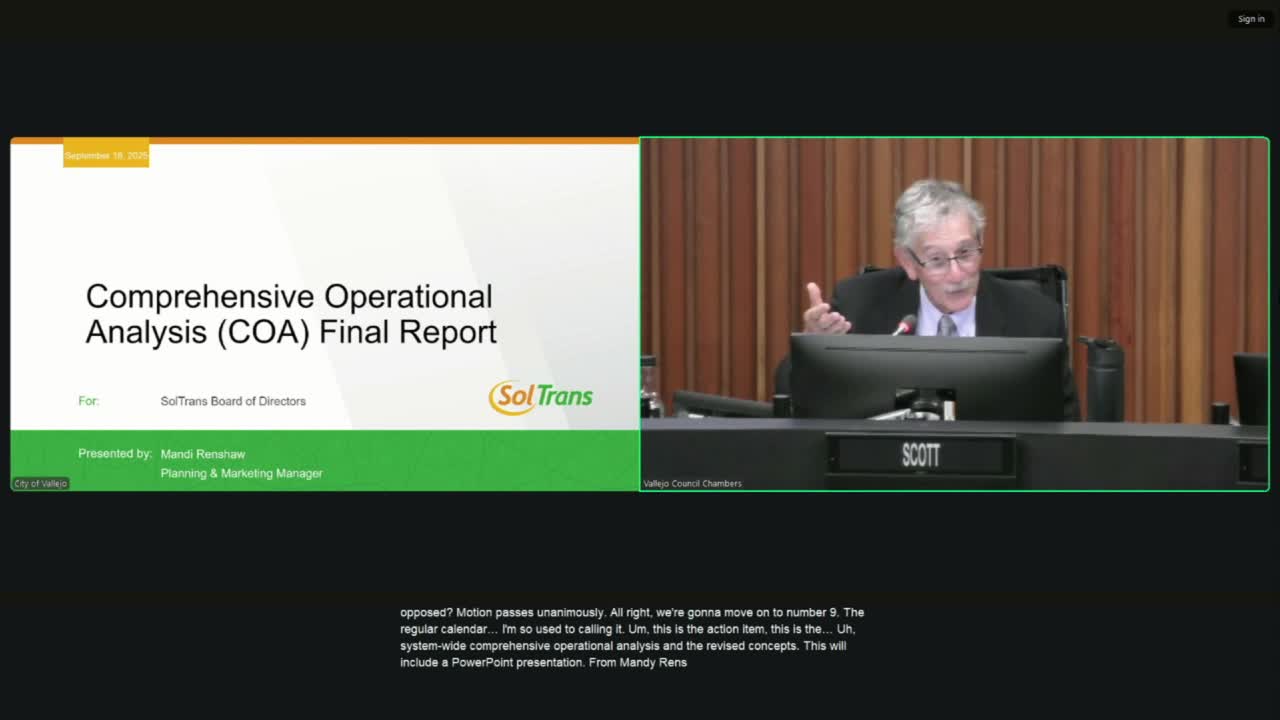
The SolTrans Board of Directors voted unanimously Sept. 23 to adopt a budget‑neutral plan that restructures local and express routes to increase frequency, expand weekend service, and strengthen regional connections; staff were directed to begin service changes for an August 2026 rollout.
The SolTrans Board of Directors voted unanimously Sept. 23 to adopt a comprehensive operational analysis (COA) that reconfigures local and Solano Express routes to increase frequency and weekend service while keeping the plan budget‑neutral.
Mandy Renshaw, the staff lead for the COA, told the board the proposals were “data‑driven” and informed by months of outreach; she said the plan is intended to “increase frequency, expand service days and span, and most importantly, strengthen the connectivity both within SolTrans service and within our regional partners.” The staff presentation emphasized that changes would be cost neutral at the system level by reinvesting hours and mileage freed by discontinued segments into routes with higher demand.
Major local changes include combining the current Routes 1 and 2 into a bi‑directional “Grand Circle” loop (1A clockwise, 1B counterclockwise), converting Route 3 from a one‑directional loop to bi‑directional service with a new connection to Hogan Middle School, keeping and rerouting Route 4 to preserve access to the courthouse and Sutter Hospital, and discontinuing Route 5 so its resources can bolster other corridors. The Route 7 pair will receive increased frequency and be offset to provide 15‑minute service to core destinations in much of the city. Staff said these adjustments will allow weekdays to begin earlier (6 a.m.) and expand weekend service hours.
On the Solano Express side, staff proposed shifting some termini and reallocating resources to improve midday frequency on the Blue Line (proposed hourly all day service to North Concord BART) and to increase all‑day frequency toward El Cerrito del Norte BART on the Red/Green corridors. As part of that reallocation, staff recommended discontinuing Route 82 and discontinuing direct service to Davis while retaining options for future discussion on Davis service.
Board members pressed staff on regional knock‑on effects, particularly the change of express termini from Walnut Creek to North Concord and the potential fare and travel‑time consequences for riders connecting to BART. Renshaw said materials and outreach noted an estimated $0.65 incremental fare impact for some riders and that most surveyed riders reported Concord as their final destination rather than Walnut Creek. Several directors and Supervisor Mashburn raised equity concerns for low‑income riders who may pay more or travel longer on BART transfers.
Directors also raised procedural concerns about the Intercity Funding and Cost Sharing Agreement, which directs SolTrans to coordinate express‑service changes through STA committee structures and the STA board. Staff replied that implementation would be phased over the coming year and that the changes approved by the local board would not take effect until after regional approvals and the planned implementation window beginning in August 2026.
The board adopted a motion to receive the final COA, approve the revised concepts, and direct staff to begin the public service‑change process; the motion passed unanimously. The board asked staff to continue outreach focused on paratransit customers, colleges (DVC and Solano Community College Vallejo campus), and other riders most affected by routing and transfer changes. Staff said they will report back through the regional consortium and STA committee structure as required.
Next steps: staff will begin the formal service‑change process, conduct additional rider outreach, and work with regional partners on any interagency approvals required before the August 2026 implementation window.