Get Full Government Meeting Transcripts, Videos, & Alerts Forever!
Get email alerts on the Climate Action Plan topic
No spam. Unsubscribe anytime.
Wilsonville commission reviews draft Climate Action Plan with retrofit, transport and solar targets
Summary
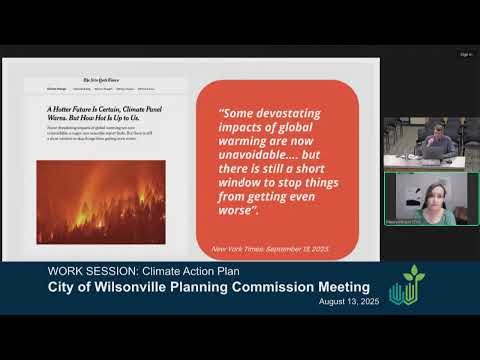
Wilsonville planning commissioners heard a consultant presentation on Aug. 13 outlining a draft Climate Action Plan that models a low‑carbon pathway and proposes 10 actions across buildings, transportation, renewables, industry and waste.
Wilsonville — The Planning Commission on Aug. 13 reviewed a draft Climate Action Plan that models multiple scenarios and proposes 10 actions to reduce the city’s greenhouse‑gas emissions.
City Natural Resources Manager Carrie Rappold and consultants from Sustainability Solutions Group presented technical modeling, potential implementation measures and next steps. Consultant Maria Brown summarized the plan’s low‑carbon pathway: “We see emissions decreasing by 41% by 2030, 72% by 2040 and 83% by 2050,” if the proposed actions are implemented.
The plan groups measures into five areas — buildings, industry, transportation, renewable energy and waste/green infrastructure — and models their combined effect. For buildings, the team modeled retrofitting existing structures to reduce average energy use by 50%, an action Brown said would account for roughly one‑quarter of projected future reductions. Brown also noted a local job co‑benefit: “I believe it was something around 9 jobs per million dollars of capital invested in retrofitting existing buildings.”
On transportation, the plan models both mode shift (shorter trips replaced by walking, cycling and transit) and a transition to zero‑emission vehicles (electric or hydrogen), with a modeled full light‑duty uptake by the 2035–2040 timeframe. For renewable energy, the consultants estimated installing about 36 megawatts of rooftop solar on new buildings and about 297 megawatts on existing roofs; Brown said maximizing rooftop solar and voluntary green‑electricity purchases could eliminate roughly one‑third of the community’s future emissions.
Commissioners focused their questions on two practical issues: financing and local specificity. Commissioner Andrew Carr asked that the appendix and subsequent financial analysis show emissions reductions and return‑on‑investment by action so the city can prioritize dollars. Brown said the next phase would be a financial analysis that quantifies capital needs, savings and which actors (city, residents, businesses) would bear costs.
Several commissioners raised policy and technical clarifications. Commissioner Sam Skoll asked whether changes at the federal level would alter the plan’s assumptions; Brown replied that “the work that has to be done ... remains the same,” while acknowledging federal funding or efficiency standards can affect the pace and cost of implementation. Commissioner Ron Heberlein urged consistent language, suggesting the plan use “zero‑emission vehicles” as technology‑neutral terminology, and asked about emissions embedded in landscaping and irrigation; staff explained irrigation energy and treatment are included in the inventory and suggested shifting gas landscaping equipment to electric as a mitigation option.
Presenters also committed to pulling a geographic breakdown for the town‑center zone so the commission can see how the plan’s measures interact with the town‑center development. They agreed to clarify terminology in the document (distinguishing actions from implementation measures) and to provide a tracked‑changes version of the updated draft.
Next steps: staff said the plan will be presented to City Council for a work session on Sept. 4 and that the Planning Commission will hold a public hearing on Oct. 8 to receive formal public testimony before finalizing recommendations. The commission approved the previously distributed July 9 minutes earlier in the meeting.
The presentation materials outline targets that align with state goals — a 45% reduction by 2035 and an 80% reduction by 2050 (relative to 1990 levels) — and identify further questions about who will lead implementation, how projects will be financed, and the timing of specific programs. Commissioners requested more detailed financial and per‑action reduction data before the public hearing.