Get Full Government Meeting Transcripts, Videos, & Alerts Forever!
Get email alerts on the Street Maintenance topic
No spam. Unsubscribe anytime.
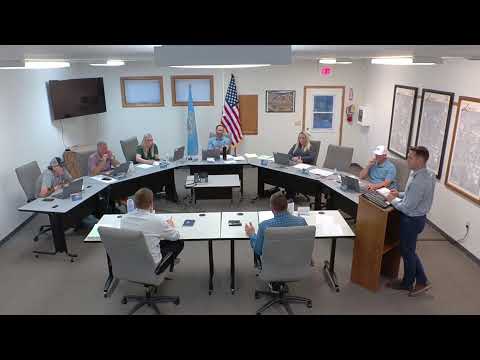
Lennox council advances street-maintenance fee resolution after lengthy engineer briefing
Summary
Council advanced a resolution to increase street-maintenance funding after engineer Mitch presented a mill-and-overlay plan, cost estimates and multiple assessment options; the measure passed by voice vote and will appear on next spring’s tax bills if adopted as final.
Mitch, the town’s engineer, told the Lennox City Council that the town’s street system has grown and that keeping up with pavement life will require higher, dedicated funding. "If you really look at your street system ... you'd find that the unit price that you have to set is much higher than we're gonna talk about tonight," he said, urging the council to consider larger assessments to support mill-and-overlay work as streets reach the end of their service lives.
The presentation reviewed the town’s pavement history and condition index, noting roughly 90,700 linear feet of asphalt with about 40% rated in top condition and roughly 35% in poor condition. Mitch said recent slurry-seal work has extended pavement life but that some streets have reached 20–25 years and now need mill-and-overlay or full replacement. He estimated roughly $151,000 per year would be required to maintain a seven-year rotation on the areas targeted for mill-and-overlay at current unit prices (about $3.50 per square yard), and calculated a separate slurry-seal funding need of about $1.15 per front foot (today’s dollars, no inflation).
The technical memo presented options for how the town collects the charge (front footage versus square footage), identified candidate streets and showed how shorter collection windows for particular projects raise the per-front-foot cost. Mitch said the town could change the assessment methodology, noting Harrisburg had moved from front-foot to square-foot assessments to deal with irregular lots, but cautioned such changes require detailed modeling to avoid unexpected shifts in burden.
Council debate focused on how quickly to raise rates and on fairness of different assessment methods. "I would never wanna make a jump as dramatic as $2 to $3.31," Council member (Speaker 3) said, supporting incremental increases and stating, "I'm in a proponent of increasing in the same incremental style we've gone at 50¢ a linear foot and moving to $2.50." Other council members and staff emphasized the trade-off between household impacts and avoiding larger, reactive replacement costs later.
After discussion the council moved to advance the street-maintenance resolution identified in the meeting as "20 25 dash O8Dash11 dash o 3." The motion to advance was made by Council member (Speaker 3), seconded by Council member (Speaker 1), and passed by voice vote; the presiding official announced the motion carries. Staff confirmed any change to the front-foot rate would appear on the next spring tax bill, meaning residents would first see the adjusted assessment on the first tax bill after final implementation.
The council directed staff and the engineer to continue refining project timing, collection methodology and public notice materials. The resolution was advanced; the council then moved into executive session for legal matters.
The council did not adopt a final per-foot rate in this meeting; the discussion and the advanced resolution set the council’s direction toward increasing dedicated street-maintenance funding and moving more projects from seal coats to mill-and-overlay work.