Eagle Pass Waterworks board adopts resolution backing four‑lane upgrade of U.S. 57; local leaders vow coordinated push to speed funding
Loading...
Summary
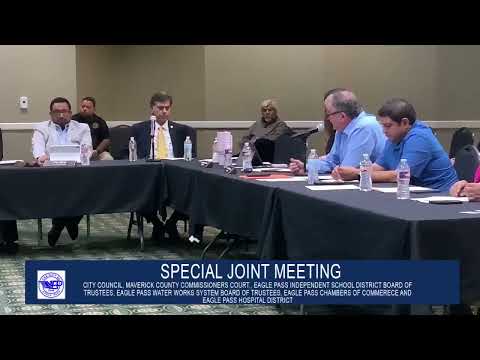
At a joint workshop Aug. 6, 2025, local officials and TxDOT representatives agreed to pursue design and funding for converting U.S. 57 to a four‑lane divided highway. The City of Eagle Pass Waterworks Board unanimously adopted a resolution supporting the project and urged other bodies to pass similar measures to bolster the case to the Texas DOT.
EAGLE PASS, Texas — Local officials and Texas Department of Transportation consultants meeting at the International Center for Trade on Aug. 6, 2025 urged a coordinated campaign to advance U.S. 57 from a two‑lane road to a four‑lane divided highway, and the Board of Trustees of the City of Eagle Pass Waterworks unanimously adopted a resolution backing the project.
Tom Ellis, the general engineering consultant TxDOT has assigned to oversee design work on the 98‑mile corridor, told the joint workshop that advancing the project will require community consensus and ready‑to‑go engineering plans. "US 57 is about maybe $800 million in construction," Ellis said, noting that statewide competition for funds makes having shovel‑ready segments and local commitment essential to secure construction dollars.
The draft resolution read at the meeting cites rising traffic and safety concerns — including a statement that commercial motor vehicles make up "over 20%" of traffic on U.S. 57 and that, for 2017–2022, fatal crashes involving commercial vehicles represented nearly one‑third of roadway fatalities — and notes TxDOT has designated the corridor on the Texas Highway Freight Network and the National Highway Freight Network.
The Waterworks board, which had quorum, moved and seconded adoption of the resolution; Chair Benny Rodriguez moved the measure and Diana Salinas seconded it. "So we have a unanimous decision of those present," the chair said after the vote. The resolution supports planning, design, construction, operations and maintenance of a four‑lane divided U.S. 57 and requests that participating entities tailor and pass their own versions.
Officials at the meeting discussed next steps to move the corridor into the Unified Transportation Program (UTP) and before the Texas Transportation Commission. Speaker and local leaders said the Transportation Commission’s adoption of the UTP later in August makes immediate coordination and visible advocacy in Austin important. A TxDOT staffer said the current priority is to break the corridor into prioritized segments, complete environmental and schematic work, and address the usual schedule drivers — right‑of‑way acquisition and utility relocations — which often form the critical path to construction.
Representative Morales and others recommended unified, sustained representation in Austin, and local lobbyists present said they would help arrange meetings with commissioners and explore whether parts of the district might host a commission meeting locally. Chamber and business leaders urged involving neighboring jurisdictions and tribes — including the Kickapoo Tribe — so commercial‑traffic patterns on the Mexico side also reflect regional planning.
Meeting participants discussed funding approaches, including directing newly available Metropolitan Planning Organization funds toward right‑of‑way acquisition or other actions that would improve the project’s competitiveness. The MPO representative, Placido Madera, pressed staff about which UTP categories the corridor might qualify for; TxDOT staff said statewide connectivity/rural categories were likely candidates and reiterated that shovel‑ready segments score better for constrained funds.
Tom Ellis and TxDOT staff underscored the practical barriers: limited right‑of‑way in some sections, environmental and utility relocations, and rising construction costs. "We can't just ask for the whole project," Ellis said, urging a phased, detailed plan that local governments and partners could present to state decision makers. Representative Morales added a sense of urgency, saying the community "doesn't have 10 years" to wait for delivery and urging local entities to show they are "willing to put up money" and other commitments to move the project forward.
The Waterworks board’s adopted resolution calls on the city, county, school district, chamber and hospital district to pass similar resolutions and forward them to Austin. Officials said the next practical steps are to schedule expanded stakeholder meetings including affected towns along the corridor, coordinate testimony for the Transportation Commission, and seek to use MPO and local resources to make key segments shovel‑ready.
The workshop concluded after TxDOT introduced Robert Moya III as the new Del Rio area engineer and the group moved to adjourn. Several speakers said they would return to their respective boards and councils with the draft resolution for formal consideration.