Get Full Government Meeting Transcripts, Videos, & Alerts Forever!
Get email alerts on the Charter Amendments topic
No spam. Unsubscribe anytime.
Conroe council sends broad package of charter amendments to November ballot after debate
Summary
The Conroe City Council voted Aug. 14 to place a wide-ranging package of charter amendments on the Nov. 4 special-election ballot, approving most propositions after debate over timing and citizen input; Proposition B failed and Proposition E died for lack of motion.
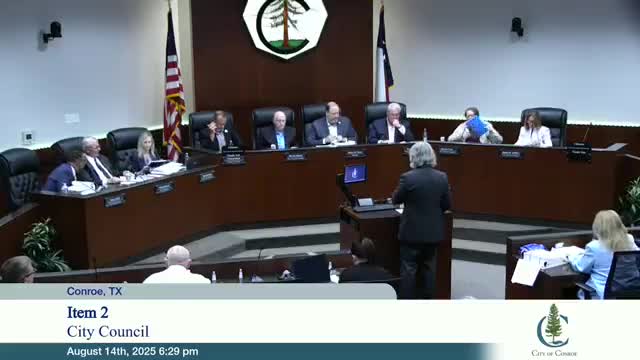
Conroe — The Conroe City Council on Aug. 14 voted to place a broad package of proposed charter amendments on a Nov. 4 special-election ballot after extended public comment and council debate.
The ordinance calling the special election passed by roll call. Councilmembers voted to send measures that would, if approved by voters, change the city's form of government to a council‑manager system; modify agenda, appointment and office rules; set recall petition requirements; and cap certain mayor and council compensation. At least one proposed change — Proposition B, to shorten terms from four years to two — failed, and Proposition E (prohibiting physical offices in city facilities for mayor/council) died for lack of motion.
Why it matters: multiple speakers at two town-hall meetings and during public comment urged the council either to slow the process or to include additional citizen-requested items. Critics warned that holding a partial package in November could bar new charter amendments for two years under state law, potentially delaying measures citizens prioritized.
What the council decided: the council approved — by motion and roll call — placement on the November ballot for the following propositions (summarized):
- Proposition A: Create council‑manager form of government — placed on the ballot after a roll-call vote in which Mayor Pro Tem Wood voted Nay and the remaining voting members approved.
- Proposition B: Reduce mayor/council terms from 4 to 2 years (and impose an 8‑year consecutive term limit) — failed to pass; will not be on the November ballot.
- Propositions C–D, F–G and I–P: A set of procedural and structural charter changes (agenda‑setting rules, quorum/voting thresholds, nomination/confirmation of department heads, board/commission confirmations, restrictions on individual authority, mayor’s disaster powers, candidate financial certification, council benefits, recall-petition rules, special‑meeting thresholds, deletion of secretary-as-finance-director provision, and debt limits) — all were approved for placement on the November ballot.
- Proposition Q: Initially drafted as a fixed-dollar limit on debt issuances without voter approval, the council amended it to limit debt to no more than 10% of the city’s total budget per item; that amendment and the amended proposition were approved for the ballot.
Public input and council concerns: dozens of residents spoke during the citizens-inquiry portion, with recurring themes including the proposed Blackfin compressor‑station project, transparency around development and debt, and the pace of the charter process. Sandra Burke and others warned that approving a partial, administrator-driven package in November risked locking out citizen-prioritized measures for two years.
Next steps: The city has called a public hearing and additional procedures tied to the Nov. 4 special election; the council also set the ordinance and related procedural steps in motion. Voters will decide the approved propositions on Nov. 4, 2025.