Get Full Government Meeting Transcripts, Videos, & Alerts Forever!
Get email alerts on the Opioid Response Programs topic
No spam. Unsubscribe anytime.
Burke County advisory committee endorses three opioid‑settlement programs for contracting
Summary
An advisory committee unanimously endorsed contracts for A Caring Alternative, High Country Community Health and SPARK to expand substance-use services in Burke County; staff will move the proposals to the Board of Commissioners for final approval and contracts are expected to be finalized in September.
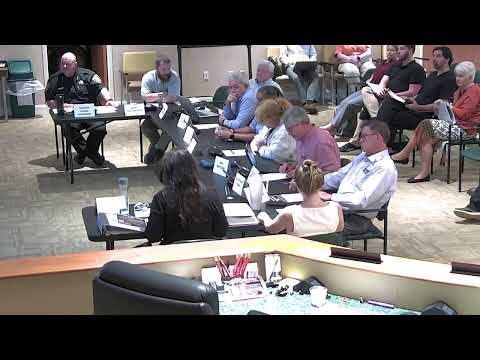
At a special Burke County advisory committee meeting, members voted to endorse three programs selected through a recent RFP to use opioid‑settlement funds and authorized staff to proceed to contracting.
Dr. Katie Samuels, a county staff member who led the RFP process, told the committee the county received 11 proposals between June 13 and July 11 and that three vendors — A Caring Alternative, High Country Community Health and SPARK — passed internal and committee review. "With your endorsement, we'll be able to take these proposals to the Board of Commission for final approval and start implementing some of these projects," Samuels said.
A Caring Alternative requested up to $300,000 to establish a Substance Abuse Comprehensive Outpatient Treatment (SACOT) program and a Substance Abuse Intensive Outpatient Program (SA IOP) inside Burke County. Tekken Brown, chief operations officer at A Caring Alternative, described the proposed schedule and staffing: SACOT would run five days a week and SA IOP would run three days a week with morning and evening groups. Brown said the county contract would include performance milestones and tracking: "We're looking at two groups running by the end of month nine with a goal of one evening and one morning group per each service by the end of the year." Committee members pressed on transportation, eligibility, and what happens when clients miss sessions; Brown said peer support and assertive outreach would be used to re-engage participants.
High Country Community Health proposed expanding low‑barrier, street‑based outreach, rapid Suboxone initiation, Hepatitis C testing and treatment and hiring clinical staff including a psychiatric nurse practitioner and a clinical pharmacist. Alice Salthouse, High Country's CEO, said the organization is an FQHC eligible for public-insurance reimbursement and that the expansion is intended to be sustainable beyond settlement funding. "Our model is already built to last and is sustainable," Salthouse said. Thomas Wilson, interim director for grants management, added the organization already provides MAT and field outreach and would use these funds to expand capacity and reduce any delay in service delivery.
SPARK proposed a Family Centered Treatment Recovery (FCTR) pilot to serve families where substance use is affecting child welfare outcomes. Terry Herman, SPARK's senior vice president for strategy and development, said the pilot would be a fee‑for‑service model with startup costs and training required by the Family Centered Treatment Foundation and a goal to serve 20 families in the first contract year. The program includes contingency management incentives and aims to make FCTR Medicaid‑billable within six to nine months.
During discussion, a committee member raised concerns that syringe‑exchange services could normalize drug use; Dr. Tom Meek and provider staff responded that harm‑reduction outreach, sterile needle provision and rapid linkage to treatment have public‑health benefits including reduced hepatitis C transmission and opportunities to engage people in care. "There's risk in any type of treatment," Dr. Meek said. "But to the best of my understanding ... it is a sterile needle that will have the impact to decrease the transmission of sharing, to decrease HIV, hepatitis C, etc." The transcript also records a slide/contract amount discrepancy for High Country that staff said they would revisit during contracting.
The committee then voted on motions to endorse each program and to proceed with contracting; for each motion the record shows uplifted‑hand votes with no opposed hands and the chair stated that "that is all of us." The endorsements authorize county staff to draft and negotiate performance‑based contracts and return to the Board of Commissioners for final approval; Samuels said the Board consideration is expected next week and contracts could be finalized in September.
The advisory committee also highlighted an Overdose Awareness Day memorial on Aug. 30 and set the next committee meeting for Sept. 16. The transcript does not record detailed vote tallies by individual name, and contracting-level specifics (final award amounts and exact performance metrics) will be determined during the contracting process.