Get Full Government Meeting Transcripts, Videos, & Alerts Forever!
Get email alerts on the Mayor Budget topic
No spam. Unsubscribe anytime.
Deputy mayor presents mayor—s 2026 city budget priorities, highlights reserves and economic development shift
Summary
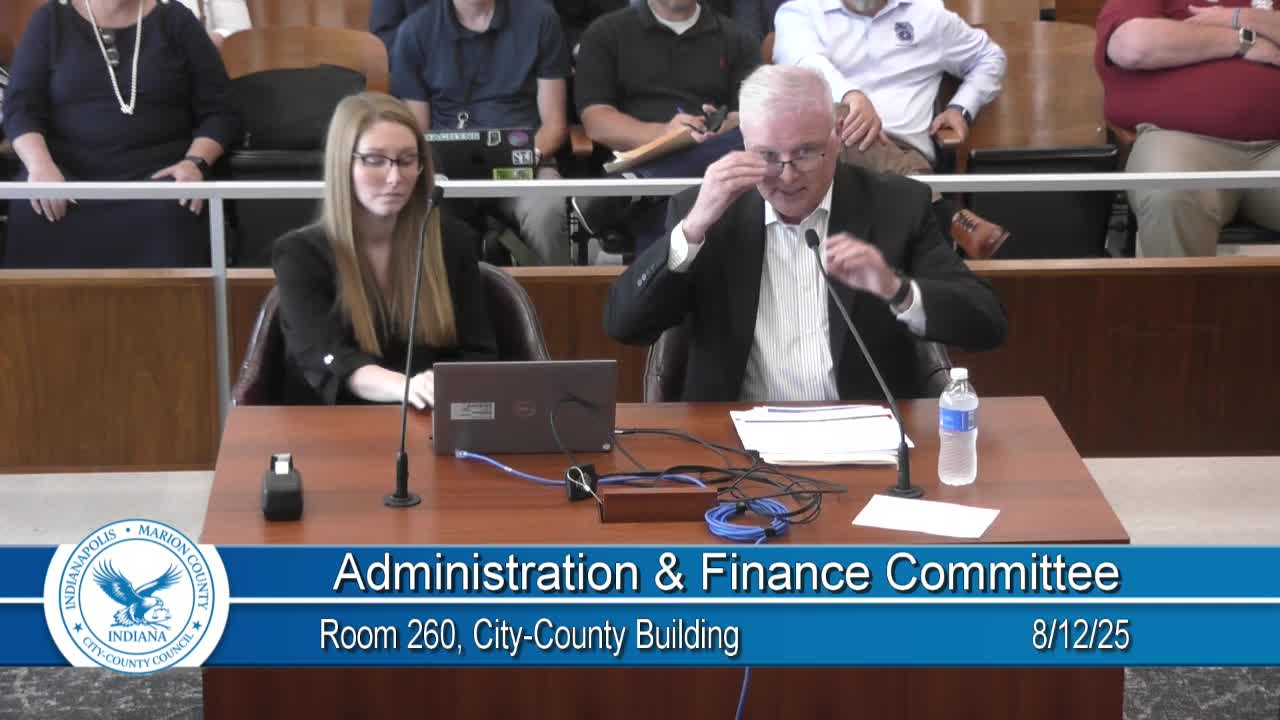
Chief Deputy Mayor Dan Parker told the Administration & Finance Committee the mayor—s 2026 consolidated budget is balanced with no tax increases, preserves key investments through 4% reserves, and eliminates the Deputy Mayor for Economic Development post after creating a new nonprofit, Indy Economic Development, Inc.
Chief Deputy Mayor Dan Parker presented the consolidated 2026 budget for the Office of the Mayor, telling the Administration & Finance Committee the plan is the ninth consecutive balanced budget and includes no tax increases.
Parker said six objectives guided the budget: a fully balanced plan; no tax increases; full funding of negotiated labor contracts; planning for legislative changes including Senate Bill 1; capturing opportunities from House Bill 1461; and protecting key investments by keeping reserves. He said agencies were asked to hold 4% in reserve and the mayor—s office complied.
On staffing and organization, Parker reviewed the mayor's office chart and named leaders including Natalie VanDogen (Director, Community Outreach), Shay Joyce (Director of Government Affairs) and Ned Wiesel (budget lead). He said women comprise a majority of positions on the mayor's cabinet and noted the office—s emphasis on transparency and collaboration with council leadership during the budget process.
Parker announced a $130,000 reduction attributable to the elimination of the Deputy Mayor of Economic Development position. He explained the city created a standalone nonprofit—Indy Economic Development, Inc.—and moved some city contracts and functions to the nonprofit, including work previously handled by the Indy Chamber and a DMD-funded position intended to expedite permitting for development projects.
Parker credited the administration—s public-safety investments, including a partnership with the National Institute for Criminal Justice Reform (referred to in the presentation as "Nick Jr."), with major crime reductions. He cited a roughly 50% decrease in criminal homicides since 2021 and about a 47% drop in nonfatal shootings since 2021, and said the city plans continued collaboration and funding.
The presentation also described investments in parks and trails tied to Lilly Endowment support and a $25 million council match, the Circle City Readers education program, continued hiring for IMPD and IFD recruit classes, tenant-advocacy funding in OPHS, and an education initiative managed through a city contract for a project manager on the Indianapolis Local Education Alliance.
Parker said the mayor's office supports a technical clarification to allow the Mayor's Action Center to be organized operationally and flagged a forthcoming proposal, backed by Teamsters Local 135, that would adjust confidential-employee language for certain mayor's office positions. He said the administration would support the committee—s consideration of that change.
The committee pressed Parker on homelessness, equity between neighborhoods for capital investment and the details of OEI (Office of Education Innovation) funding, including a $79,000 reduction Parker described as a right-sizing tied to changes in state law and the addition of $400,000 for Circle City Readers to cover the remainder of the school year.