Get Full Government Meeting Transcripts, Videos, & Alerts Forever!
Get email alerts on the Environmental Remediation topic
No spam. Unsubscribe anytime.
Commission confronts huge cleanup estimate for Shaves Lake; staff narrow focus to upland remediation
Summary
A consultant estimated $135 million to fully remediate Shaves Lake; city staff said they will instead seek a targeted upland cleanup to preserve open‑space credit, estimate $10–15 million, pursue CRA partnership and grants, and seek DEP/Broward County clarity.
Commissioners pressed staff on remediation options for Shaves Lake after the city informed the commission of a consultant figure to fully remediate the 35‑acre site. City staff said the consultant's full‑cleanup estimate was about $135,000,000 but emphasized that staff had asked the consultant to refine numbers to focus on upland areas only — roughly 2–2.5 acres — which staff estimate could be addressed for about $10–$15 million.
City Manager Dr. Earl explained the difference between cleaning the entire lake (including sediment and dredging) and remediating the land so Broward County will continue to count it as park/open space. "The number that we received today from the consultant was a $135,000,000 — that is if we are going to completely remediate Shaves Lake," staff said, adding they would return with revised, narrower options targeted at preserving open‑space credit.
Staff described practical constraints: remediation of lake water and sediment would require specialized disposal (federal facilities out of state were cited) and far larger budgets, while focusing only on contaminated upland soils and capping could preserve the voters’ expectation of parkland at far lower cost. Staff said they will seek input from Broward County and the Florida Department of Environmental Protection on remediation standards and pursue all possible grants and CRA partnership to share costs.
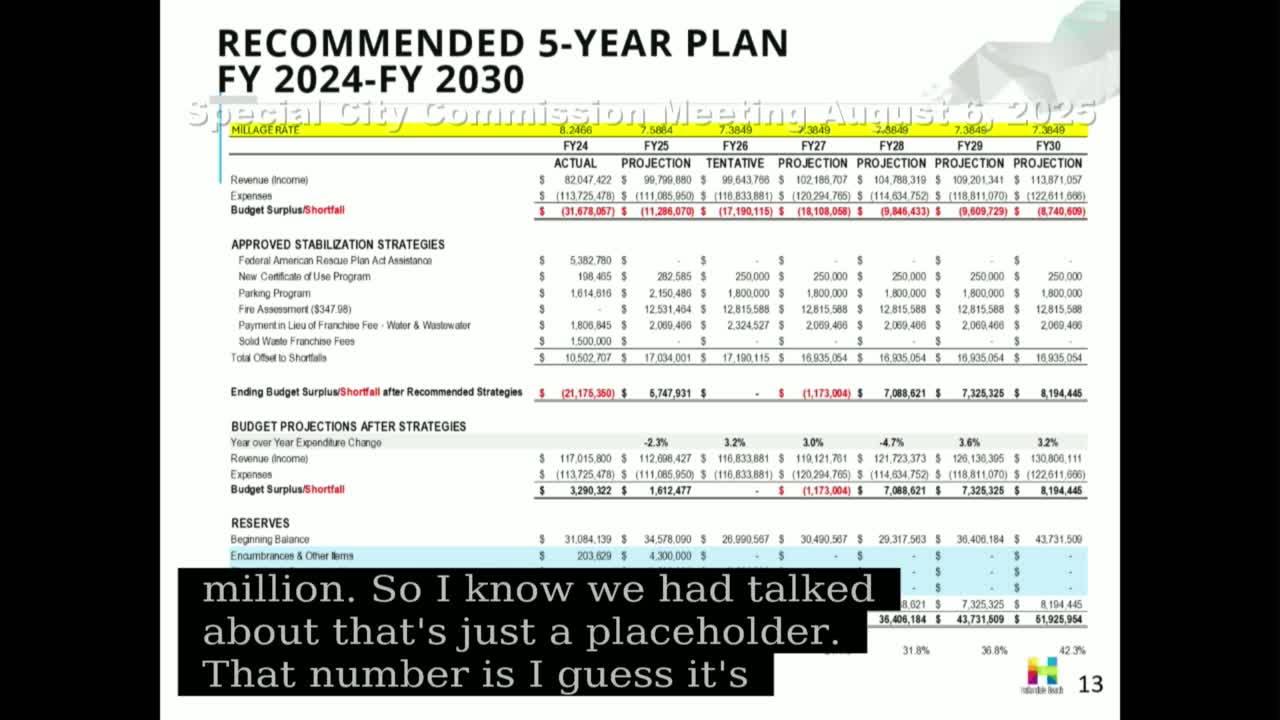
Commissioners debated alternatives: some argued the city should use a placeholder of $10 million in FY26 to hold the option open; others urged exploring buying other parcels or creating multiple pocket parks rather than spending on a costly remediation effort. Concerns included the scale of taxpayer burden, equity between high‑value and modest households, and preserving the city's required open‑space calculations.
Next steps: staff will refine the consultant's scope and return with a narrower remediation plan, cost breakdowns, grant opportunities and CRA coordination before final budget adoption.