Get Full Government Meeting Transcripts, Videos, & Alerts Forever!
Get email alerts on the Lead Service Lines topic
No spam. Unsubscribe anytime.
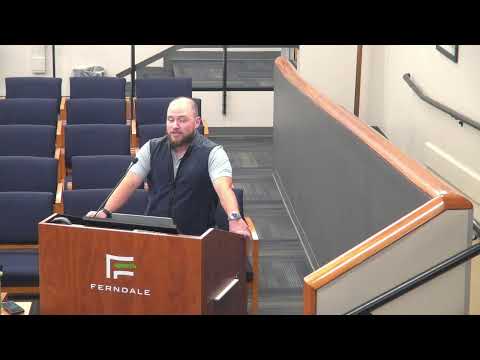
Ferndale council tables request to hire two DPW workers for lead service line program
Summary
After a lengthy presentation on the city’s lead service line replacement program, council moved to table a request to hire two DPW laborers pending a revised proposal and financial analysis at the Nov. 10 meeting.
DPW Director James Jamieson recommended adding two full‑time DPW laborers to perform in‑house verifications for Ferndale’s lead service line replacement program, but the city council voted to table that staffing request until the Nov. 10 meeting to allow staff to revise the plan and provide more analysis.
Jamieson said there is “no safe level of lead in drinking water” and reminded the council that state and federal rules require verification of all public and private service lines by Dec. 31, 2037. He described recent program work — about 141 replacements this year and roughly 2,000 total replacements to date — and said the city has roughly 6,000 service lines of unknown material left to verify. Jamieson estimated a full‑program cost of $34 million to $40 million and said internal verifications could save an estimated $1 million to $1.75 million over 12 years by capturing GIS integration and reducing long‑term contractor costs.
Councilmembers pressed staff on the verification timeline and on how the two hires would be funded. Several members said aggressive verification is important both for infrastructure planning and for informing residents about risks and mitigation. Councilmember Merrill emphasized residents’ need for verification data, saying that “I would rather verify as much upfront as I can to start to better understand how truly big the problem is” and that verification helps households know whether to take mitigation steps now.
Other councilmembers raised concerns about adding permanent headcount for what some described as a seasonal verification workload, requested clearer options (longer verification seasons, shared-services or regional contracts), and urged staff to show how the two positions would be allocated between verification and other DPW duties. Jamieson said two full‑time laborers (grade 1, step 1 and step 2) would cost roughly $167,000 in fully burdened wages plus equipment and materials (vector truck, hydrovac unit, trailers, supplies).
Councilmember [speaker 4] moved to table the hiring request to the Nov. 10 regular meeting so the city manager, DPW director and LSLR project manager could present a revised proposal; that motion passed on roll call. The council did not adopt the staffing request at this meeting. The Nov. 10 packet is expected to include a condensed set of alternatives and more detailed budget impacts.
The presentation also included resident guidance: use the city’s self‑reporting tool to identify service‑line materials, flush pipes, use cold water for consumption, and consider point‑of‑use filters. Jamieson said self reports are helpful but that outside (public‑side) verification remains necessary under state rules.