Get Full Government Meeting Transcripts, Videos, & Alerts Forever!
Get email alerts on the Transit Update topic
No spam. Unsubscribe anytime.
County staff brief council on BRT progress, funding outlook and Ride On service changes
Summary
MCDOT and Ride On staff updated the Transportation & Environment Committee on progress across five FLASH/BRT corridors—Veirs Mill Road, MD‑355 Central, US‑29, New Hampshire Avenue and North Bethesda—discussing federal grant timelines, property impacts and Ride On service and fare‑free ridership (about 61,000 daily).
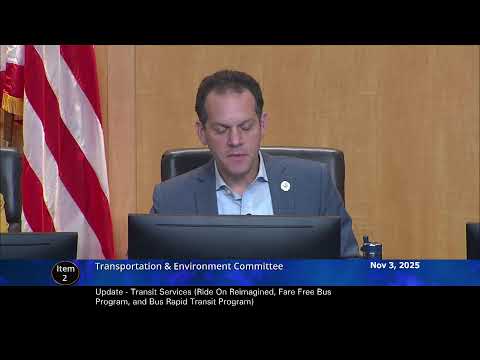
Montgomery County Transportation staff and Ride On managers briefed the council’s Transportation & Environment Committee on Nov. 3 about progress and next steps for the county’s Bus Rapid Transit (FLASH) program, the Ride On Reimagined service plan and the countywide transition to fare‑free buses.
Joanna Conklin, the county’s BRT program manager, described FLASH as a planned network of eight upgraded BRT corridors with dedicated lanes, branded vehicles, level boarding and station amenities intended to improve speed, reliability and access. Conklin said households within a half‑mile of a FLASH station include higher shares of low‑income residents, people of color and households without vehicles, making the program an equity priority.
Jamie Henson, BRT project implementation manager, gave corridor‑level updates: Veirs Mill Road is a 7.6‑mile project with 12 stations, estimated at slightly more than $200 million in the approved CIP; completed NEPA and design work, utility relocations underway and property acquisition started for roughly 137 properties (the team estimates permanent easements will be needed on about 75% of those properties). The county is pursuing the Small Starts federal category and is seeking the program maximum federal share ($150 million) for that corridor. Henson said the county’s federal funding application is pending and that the project team has begun heavier construction preparations for next year.
For MD‑355 Central, Henson said the corridor is about 15.5 miles with three service lines, an approved CIP cost of roughly $450 million and a New Starts application in process; the draft NEPA document was recently received and the county is near selection of a progressive design‑builder with substantive construction anticipated after final design (staff estimated more substantive construction in calendar year 2028). Phase 2 of US‑29 (about five miles of median bus lanes) is at ~35% design and is projected to reduce southbound AM transit travel time by about 40% compared with a no‑build scenario.
Several councilmembers pressed staff about costs, phasing and the risk that the county will not secure federal grants. Chair Glass noted the county previously funded the first BRT elements and that funding remains the central constraint; staff emphasized that FTA feedback has been positive but that grant awards are not guaranteed until agreements are signed.
Councilmembers and staff also discussed University Boulevard, where existing dedicated bus lanes are not, by MCDOT standards, full BRT because they lack the stations and other branded elements. Planning‑board actions tied to the University Boulevard corridor master plan could designate additional transit lanes and guide future studies; those planning designations do not by themselves fund projects.
Phil McLaughlin, Ride On general manager, presented the system status: Ride On operates 83 fixed routes, two flex zones (with a third slated for the Northern New Hampshire/White Oak area in January), a fleet of almost 400 vehicles, and carries about 61,000 riders per weekday (FY25 ridership reported +4% over FY24; FY24 up ~27% over FY23). McLaughlin attributed short‑term gains in part to service swaps with WMATA and the June 29 launch of countywide zero‑fare Ride On (staff estimated the zero‑fare program has contributed roughly 1–2% of recent ridership gains, with fuller analysis to follow after more quarterly data).
Ride On staff said the agency has about 50 battery electric buses now (roughly 20–25% of the fleet) and expects about 60 additional battery buses in the coming year as part of a zero‑emission transition plan. Service changes already implemented include a new Route 40 that carries 4–5,000 riders per day and the pink/lime Ride On Extra routes in the Shady Grove corridor that each average roughly 500 riders per day.
Councilmembers asked about community engagement steps, how property acquisition negotiations are handled (staff said the county sends letters, appraises property, makes offers, and uses an acquisition incentive program that can add about 10% to the sale price to encourage quick closings; staff said eminent‑domain authority exists but is not the preferred approach), and whether materials still using older place names ("White Flint") will be updated to "North Bethesda." Staff agreed to follow up on operational issues (such as Route 100 weekend delays) and to correct naming in outreach materials.
Next steps: staff will continue federal grant work, pursue community engagement and planning‑board reviews for the remaining corridors, and councils will consider funding for MD‑355 in an upcoming joint committee discussion on financing.