Get Full Government Meeting Transcripts, Videos, & Alerts Forever!
Get email alerts on the Homeless Navigation Center topic
No spam. Unsubscribe anytime.
Austin Council approves $4.3 million purchase for city-run homeless navigation center amid heavy neighborhood protest
Summary
After hours of public testimony for and against, the Austin City Council on Oct. 9 voted 8–3 to approve the purchase of a property along I‑35 for a city‑operated homeless navigation center, drawing praise from service providers and concern from nearby residents and some council members about safety and community engagement.
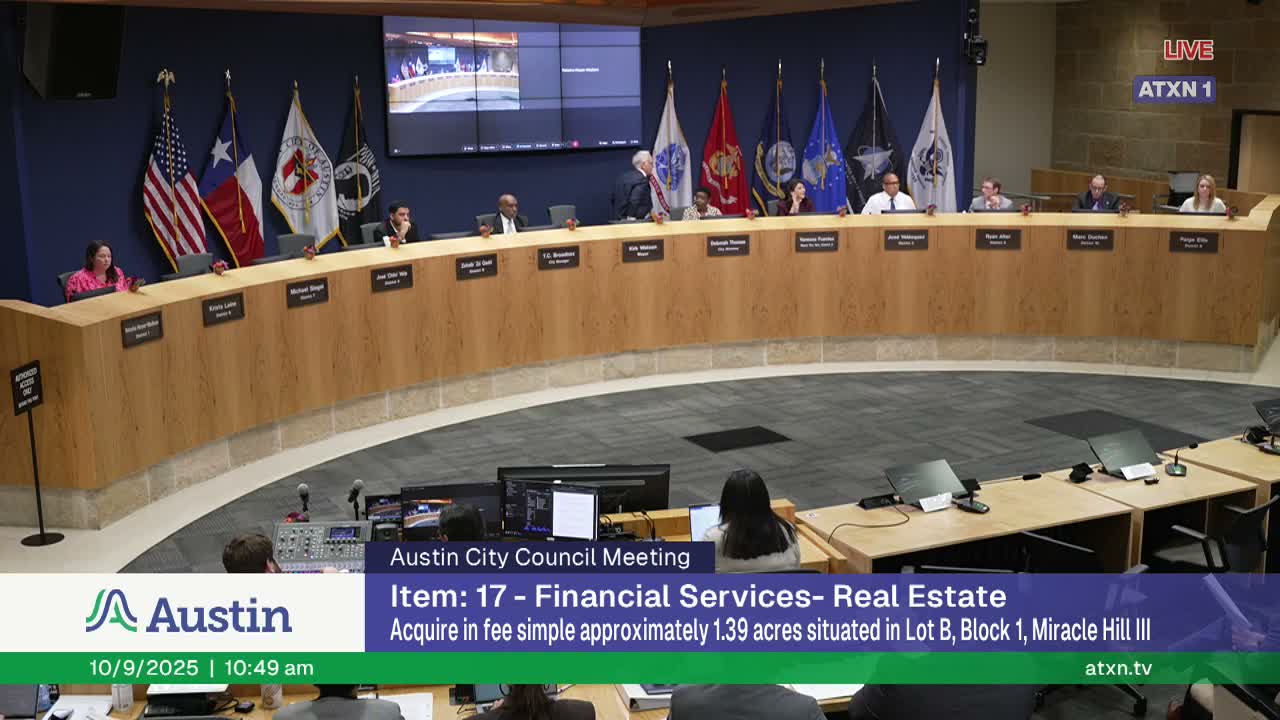
Austin — The Austin City Council voted 8–3 on Oct. 9 to approve the purchase of a property along Interstate 35 to become a city‑owned homeless navigation center, approving the acquisition after more than six hours of public testimony split between neighbors worried about proximity to schools and advocates who said the site would improve service access.
Councilmember Ryan Alter moved to approve Item 17 and Councilmember Paige Ellis seconded; the motion carried with eight votes in favor and three opposed (Councillors Duchin, Velásquez and Kadri/Cadre). Mayor Watson presided over the meeting, which convened at 10 a.m. and resumed public comment after a noon recess.
The decision follows weeks of community outreach and dozens of speakers at a marathon council session. Opponents urged delay until the city produced a detailed, binding operating and safety plan, pointing to management problems at the existing Sunrise navigation facility and to the site’s proximity to schools and residential yards. “We do not want this in our neighborhood,” one neighborhood speaker said, listing local crime and safety incidents and asking the council to postpone the purchase.
Supporters — including service providers, faith leaders and people who have used navigation services — told the council a larger, city‑run site with indoor waiting space, on‑site clinicians and wraparound services would reduce harm and speed rehousing. “When you have access to shelter, case management and nearby services, everyone wins,” said Alina Sanchez, who described reconnecting clients with family and housing through navigation services.
Several resident speakers questioned the city’s timeline and transparency. “This purchase is being asked for before a scope of services is defined, before an operator is identified and vetted, and before meaningful community agreement has taken place,” said Matthew Ewing, who opposed the acquisition and asked for a public‑safety plan and a vetted operator. Other residents recounted local crime incidents and said the selected parcel sits within walking distance of two elementary schools and a high school.
Council debate reflected those tensions. Councilmember Vanessa Velásquez, who voted no, said she opposed the item because she had not had sufficient time to review details and community input, but pledged to work with neighbors if the measure passed: “I’m voting no ... because I have personally not had enough time with this item,” she said, adding that she would "roll up my sleeves" to ensure proper implementation should the purchase proceed.
Homeless‑service advocates and nonprofit partners urged the council to act, arguing that navigation centers provide centralized intake, health and housing navigation that reduce emergency responses and help clients find stable housing. Vocal Texas leaders and faith organizations testified about personal experiences in support of expansion.
Financial and implementation specifics in the staff backup and public comments varied. Council members and speakers referenced a purchase price discussed in the meetings of about $4–4.4 million and broader budget items tied to the Homeless Strategy Office (HSO) and upcoming fiscal year requests; the council noted operational decisions and contracts would follow the acquisition.
The council also rejected a motion by Councilmember Kathie Duchin to postpone the item for 30 days for lack of a second. After the vote, Mayor Watson told the public the city would work to ensure the project meets appropriate standards and that councilmembers would be involved in oversight and community engagement as implementation proceeds.
Next steps: the council’s approval authorizes the property acquisition; staff said operational details, selection of an operator or city staffing model, and legally binding community protections will be developed in the weeks ahead and returned to council for required approvals.