Get Full Government Meeting Transcripts, Videos, & Alerts Forever!
Get email alerts on the Uga Annexation topic
No spam. Unsubscribe anytime.
Sumner council weighs annexing parts of its urban growth area; staff recommends phased study starting with Southeast parcel
Summary
Development staff presented options for annexing parts of Sumner—s urban growth area after a county request. Council directed staff to continue talks with Pierce County about the Southeast UGA (developer Terragon has applied) and to consider the West UGA later; no formal annexation vote was taken.
Sumner City Council spent the bulk of its Aug. 25 study session reviewing options for annexing portions of the city—s urban growth area (UGA) after a formal approach from Pierce County.
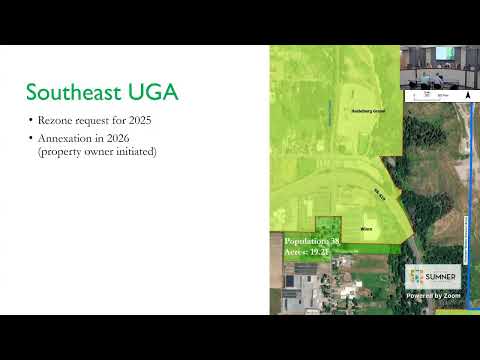
"The only reason why we are here tonight is because the county has asked us to consider annexing our UGA," Development Director Ryan Windisch said as he opened the presentation, outlining three primary areas under consideration: the East Hill (Northeast UGA), a West UGA that would connect the city—s detached cemetery area, and a Southeast UGA near the SR 410 interchange where developer Terragon already owns much of the land.
Windisch told council the combined UGA areas contain roughly 2,100 residents, about 560 dwelling units, roughly 210 jobs and about 35 small businesses; assessed value of the area was cited at about $505 million. He warned that accepting annexation would bring costs: utility upgrades (sewer is difficult on some East Hill slopes), road maintenance and police and code-enforcement workload.
Staff described annexation methods available under Washington law, including resident petitions, a 60% property-value petition (the method Terragon intends to use) and a newer interlocal agreement (ILA) route adopted in 2020 that the county has proposed. Windisch and staff noted tradeoffs: developers typically pay system development charges and impact fees when building in a city, but recurring service costs for roads and public safety can exceed near-term revenues.
Council members pressed staff about capacity and budget impacts. Several questioned whether the city has staff time to manage annexation work now and how many officers or road improvements would be required. Public-works staff cautioned that state and regional projects (SR 166 roundabout environmental work, 162/167 corridor studies) and uncertain WSDOT funding complicate timing for traffic and interchange improvements.
City staff summarized council direction at the meeting—s end: proceed with further study of the Southeast UGA (explore both the 60% petition and the ILA option), engage Pierce County about possible interlocal approaches that could yield negotiated terms, and consider the West UGA as a lower-priority cleanup; a larger Northeast annexation would be deferred until major capital projects and internal staffing capacity allow. That guidance was staff direction, not a formal annexation decision.
Next steps include staff follow-up with county planners and additional cost/benefit analysis if council confirms the path forward at a later meeting.