Get Full Government Meeting Transcripts, Videos, & Alerts Forever!
Get email alerts on the Us 57 Project topic
No spam. Unsubscribe anytime.
Eagle Pass leaders press TxDOT to speed $800 million US‑57 upgrade; Waterworks board adopts resolution
Summary
Local officials, TxDOT and business leaders met Aug. 6 in Eagle Pass to push for an accelerated conversion of U.S. 57 from two lanes to a four‑lane divided highway, urged coordinated regional resolutions and had the City of Eagle Pass Waterworks board adopt a resolution supporting the project.
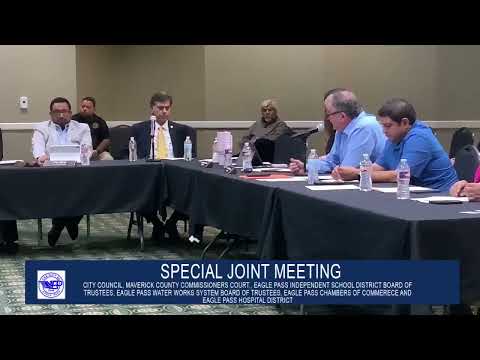
EAGLE PASS, Texas — Local officials, state transportation staff and business leaders on Aug. 6 urged faster action to convert U.S. 57 from a two‑lane road to a four‑lane divided highway, and the Board of Trustees of the City of Eagle Pass Waterworks voted to adopt a resolution backing the expansion.
Tom Ellis, the engineering consultant TxDOT contracted to advance the 98‑mile US‑57 corridor, told the joint workshop that the project will face stiff competition for limited state funds and that communities must present unified, shovel‑ready plans. "US 57 is about maybe $800 million in construction," Ellis said, stressing the need for consensus and ready plans to improve the project’s chances for funding.
State Representative Eddie Morales and other elected officials urged a faster timeline than the five‑to‑10‑year projection discussed formally by staff. "We'd like to get it to the UTP sooner than later," Morales said, referring to the Unified Transportation Program the Transportation Commission adopts. Participants agreed the group should press the TxDOT Transportation Commission and show unified local support.
The resolution read at the meeting cites increasing traffic and safety concerns, states commercial motor vehicles represent "over 20% of traffic along US 57," and notes that fatal crashes involving commercial vehicles accounted for "nearly one third" of fatalities from 2017–2022. The draft resolution calls for support of planning, design, construction, operations and maintenance of a four‑lane divided highway and includes provisions referencing border patrol station adjustments.
At the workshop the Board of Trustees of the City of Eagle Pass Waterworks — which had quorum — recorded a motion by Benny Rodriguez and a second by Diana Salinas to adopt the resolution; those present voted unanimously in favor. Workshop leaders requested that other participating entities (the City Council, Maverick County Commissioners Court, Eagle Pass ISD, the Chamber of Commerce and the Hospital District) pass similar resolutions at their next meetings and forward them to the Austin office to demonstrate unity to TxDOT.
Speakers outlined next steps to improve the project's competitiveness: prioritize segments, pursue targeted right‑of‑way acquisition and utility relocation, and public‑engagement work to raise the project's score in funding categories. A speaker from the MPO noted the organization had new funds that could contribute to right‑of‑way purchases to make segments more shovel‑ready, and lobbyists in attendance were asked to help secure attention from Transportation Commission members in Austin.
Participants also discussed regional coordination with neighboring communities (named in the meeting as La Priore and Batesville) and Mexico‑side logistics partners to ensure freight routing recognizes the corridor. Meeting participants expressed concern that inflation and rising materials costs have increased projected construction estimates since earlier planning; Ellis and others recommended phasing the work into smaller projects rather than asking for the entire 98‑mile build at once.
The meeting closed after TxDOT introduced Robert Moya III as the new area engineer, effective July 14; attendees agreed to schedule follow‑up meetings with stakeholders along the corridor and to take coordinated resolutions and presentations to the Transportation Commission.
What happens next: workshop organizers asked attendees to return to their respective governing bodies to pass or tailor the draft resolution and to send copies to the organizers’ Austin office; leaders said they will schedule a broader regional meeting to include other county judges and representatives along the corridor before seeking a formal presentation to the TxDOT Transportation Commission.