Get Full Government Meeting Transcripts, Videos, & Alerts Forever!
Get email alerts on the Rezoning West Innovation District topic
No spam. Unsubscribe anytime.
Dublin council tables West Innovation District rezoning after hours of resident testimony
Summary
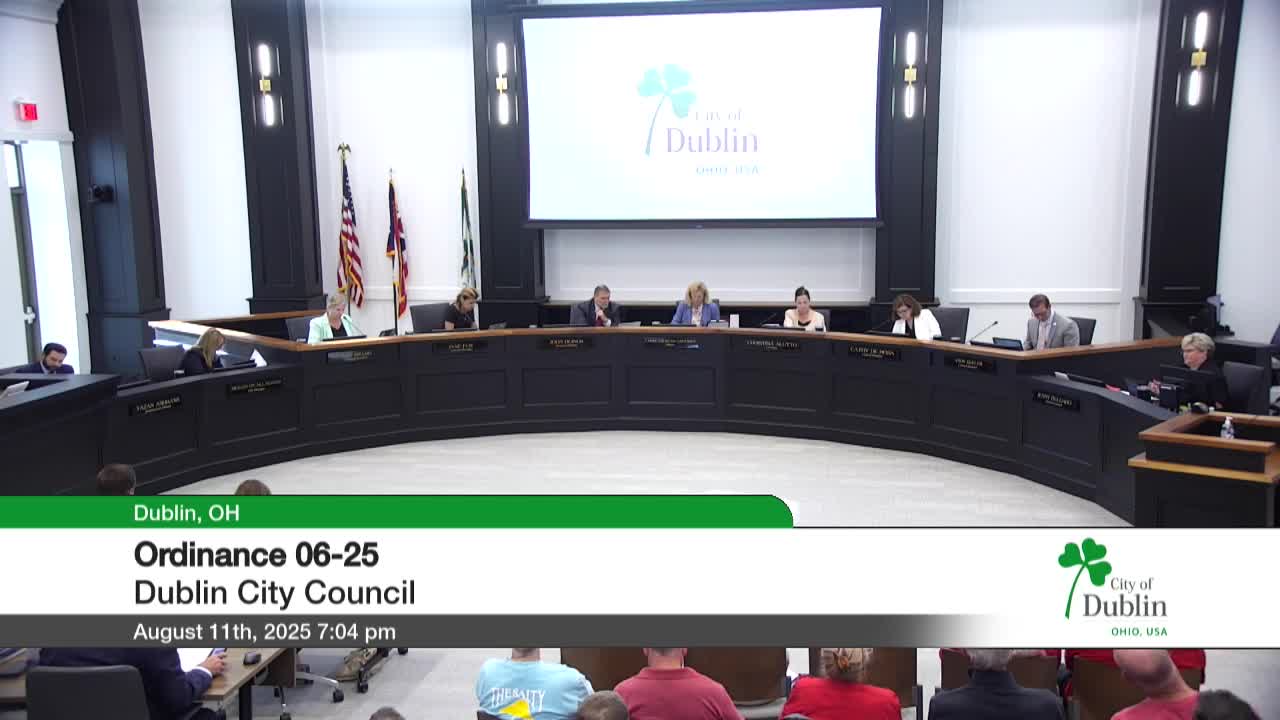
After extensive resident testimony about traffic, safety and land‑use concerns, Dublin City Council voted unanimously to table Ordinance 06‑25, a rezoning proposal for nine parcels in the West Innovation District, to allow staff to draft code amendments and pursue additional public review.
Dublin City Council voted unanimously on Aug. 11 to table Ordinance 06‑25, a proposed rezoning that would have applied industrial research and flex districts to nine parcels in the West Innovation District, after residents urged the council to slow the process and refine zoning language.
Staff planner Zach Hellenshaw told council the application covers nine parcels (about 3.70 acres as presented) including two city‑owned parcels and seven privately owned parcels, and recommended tabling the ordinance to allow code amendments and a public review process. Hellenshaw said staff is leaning toward creating a new “ID‑6” zoning district, would propose lowering maximum building heights (from 68 feet to 45 feet east of the railroad and 55 feet west), and would remove several high‑impact uses from the list of permitted activities, including data centers and certain energy utilities. "Staff is requesting Ordinance 06‑25 be tabled tonight to allow for amendments to the code through a public review process," Hellenshaw said.
Residents who opposed the rezoning said the parcels were added to the West Innovation District after earlier studies and that the city has not provided sufficient parcel‑specific analysis. Suzanne Hubert Purdy, who said she lives in The Glens at Ballantree, asked council to "preserve the last developable green space in Dublin" and to reconsider plans for industrial expansion adjacent to rural neighborhoods. Other speakers raised concerns about Cosgray Road — citing high truck volumes, crash and hazardous materials risk — and asked the city to prioritize road safety improvements before approving industrial uses.
Several residents and community representatives urged a narrow approach to permitted uses and asked that distribution centers and similar uses be removed entirely. Jennifer Hamill asked staff to provide the studies residents have repeatedly requested about the newly included parcels and said the parcels were not part of the January 2025 studies that informed earlier planning work. Timothy Myers, speaking from manufacturing experience, called for tight definitions for terms such as "manufacturing and assembly" to avoid permitting processes that could allow heavy industrial operations.
Council members thanked residents and staff for sustained engagement and repeatedly said they supported tabling the ordinance to "get it right." The mayor moved to table Ordinance 06‑25; the motion was seconded and passed by roll call with all council members voting yes. Council members and staff outlined next steps: staff will draft code amendment language, the Planning & Zoning Commission will consider the amendments at least once (and will have public hearings), and the item will return to council for at least two readings. The city estimated a multi‑month process (roughly 4–6 months) before final council consideration.
What happens next: staff will draft specific code changes (permitted uses, building heights, buffer/landscape standards and hours/service area rules) and present them to Planning & Zoning for at least one recommendation; the code will then come back to council for two readings. Residents were told there will be multiple additional opportunities (at least three) for public input during that process.