Get Full Government Meeting Transcripts, Videos, & Alerts Forever!
Get email alerts on the Warming Centers topic
No spam. Unsubscribe anytime.
Terre Haute mayor asks Vigo County to match $12,000 for winter warming centers
Summary
Mayor Brandon Sackman asked Vigo County to match the city’s $12,000 allocation, endorse a reimbursement-based funding model and sign an MOU with REACH Services to sustain low‑barrier winter warming centers; commissioners asked for firmer cost estimates and agreed Sackman should present the request to the county council for consideration.
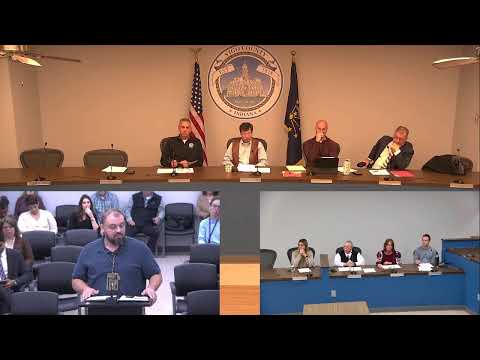
Mayor Brandon Sackman asked the Vigo County Board of Commissioners on Nov. 4 to match a $12,000 city allocation and endorse a reimbursement‑based funding model and memorandum of understanding to sustain winter warming centers operated by REACH Services.
"Our goal is simple, to make sure when temperatures become dangerously cold, every person in our community has a safe and warm place to go," Sackman said, describing warming centers as short‑term, low‑barrier emergency operations that are not traditional homeless shelters.
Sackman said REACH/Pathways will serve as the primary operator and that the city has historically cobbled together funding from the city, county and philanthropic partners. He asked the county to match the city’s $12,000 so the two jurisdictions would provide a combined $24,000 to support operations under a reimbursement arrangement, in which the operator is paid only for days the center is open.
The mayor outlined activation criteria tied to weather thresholds — apparent temperature or wind chills at or below 5 degrees, National Weather Service wind‑chill advisories or warnings, certain snow/wet conditions, or power outages leaving residents without heat — and said the plan uses unified messaging and a joint decision‑making process among the city, county, EMA and the health department to avoid past confusion about openings.
Sackman estimated REACH’s overnight capacity at about 70 people and cited a winter point‑in‑time count of 194 as evidence of a larger gap between capacity and need. He warned that state and federal funding cuts expected in 2026 could jeopardize current informal funding arrangements.
Director Joni Wise said agencies are still firming up staffing cost estimates and in‑kind donations — "one of the things we're trying to figure out is actual cost as far as staffing" — and offered to work with county staff to provide more detailed numbers.
Commissioners pressed for more detail on the budget and transportation for rural residents. Commissioner Schweitzer suggested the $12,000 request may be low for a projected 45 days of activation — "you might as well say a thousand bucks more a day," he said — and raised concerns about bringing vulnerable residents in from outlying townships where bus service and internet access are limited.
No appropriation vote took place at the meeting. Commissioners recommended Sackman present the plan to the county council so the council can consider a formal appropriation; the earliest potential timing discussed was a December meeting or a special meeting, with January or February as fallback dates if scheduling prevents a December action.
Next steps: the mayor will seek to brief the county council and the parties will return with firmer cost estimates and a proposed funding mechanism for formal consideration.